Hospital electrical distribution systems must deliver continuous, reliable power to clinical operations while maintaining compliance with NFPA 99 (Health Care Facilities Code), NFPA 70 (National Electrical Code), and NFPA 110 (Emergency and Standby Power Systems). These systems are among the most consequential physical plant infrastructure in healthcare — and among the most technically complex to manage.
Hospital Electrical System Architecture
Hospital electrical distribution differs from commercial buildings in its essential electrical system (EES) architecture, which provides backup power to critical loads during utility failures.
Service entrance — Power enters the hospital from the utility at medium voltage (typically 13.8 kV or 4.16 kV) through pad-mounted or vault-mounted transformers and switchgear. Many hospitals have redundant utility feeds from different utility substations to improve service reliability.
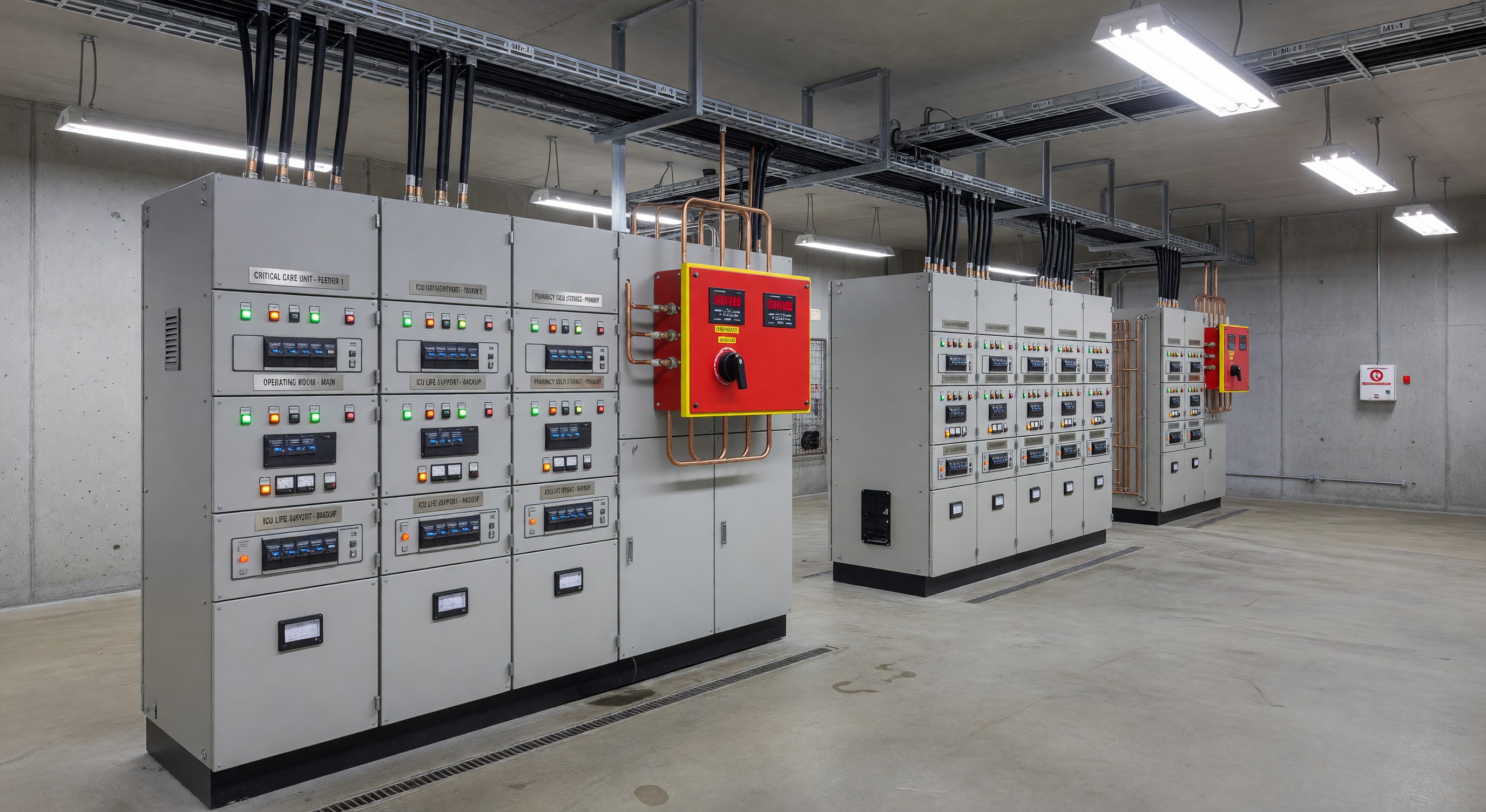
Main distribution switchgear — The main service switchgear distributes power to building substations, mechanical systems, and building distribution panelboards. Automatic transfer switches at the main distribution level detect utility failure and connect the generator supply.
Essential Electrical System — NFPA 99 requires that critical loads be served through the EES, consisting of:
- Emergency System (Life Safety Branch and Critical Branch) — must transfer within 10 seconds
- Equipment System — serves larger medical equipment and fixed equipment, no 10-second requirement
Patient care areas — NFPA 99 defines requirements for electrical wiring in patient care areas: patient care vicinity (within 6 feet of the patient), anesthetizing locations, and wet procedure locations each have specific grounding, circuit protection, and installation requirements.
NFPA 99 Electrical Requirements for Patient Care Areas
NFPA 99 Chapter 6 (Electrical Systems) establishes requirements for electrical systems in healthcare facilities:
Receptacle requirements — Patient care vicinities require a minimum number of receptacles from the normal and emergency power systems. Emergency power receptacles must be distinctively marked (typically red face receptacles) and clearly identified.
Ground fault protection — GFCI protection is required for receptacles in wet locations and specific patient care applications. However, in critical care areas, GFCI may cause nuisance tripping that interrupts monitoring equipment. NFPA 99 distinguishes GFCI requirements by risk category.
Isolated power systems — Historically required in anesthetizing locations, NFPA 99 has modified these requirements in recent editions. Facilities built under earlier codes may have isolated power panels (with line isolation monitors) that must be maintained per the standards under which they were installed.
Equipotential grounding — Patient care areas require equipotential grounding systems that minimize voltage differences between exposed conductive surfaces (equipment frames, medical devices, bed frames). Equipotential ground bonding must be installed and periodically tested.
Panelboard directory — Every panelboard in a healthcare facility must have a complete, accurate directory identifying every circuit by circuit number, area served, and load type (normal vs. emergency).
Electrical Safety: Arc Flash Hazard Analysis
Arc flash is a potentially fatal electrical safety hazard in healthcare facility electrical work. An arc flash event — an uncontrolled electrical explosion due to accidental contact between energized conductors — releases enormous amounts of energy in a fraction of a second.
NFPA 70E (Standard for Electrical Safety in the Workplace) requires that employers protect workers from arc flash hazard through:
Arc flash hazard analysis — Calculation of the incident energy (cal/cm²) and flash protection boundary for each piece of electrical equipment. This analysis requires engineering calculations and results in equipment-specific labels showing the hazard category.
Personal protective equipment (PPE) — Workers performing energized electrical work must wear PPE rated for the calculated incident energy level.
Equipment labeling — All electrical equipment where arc flash hazard exists must be labeled with the hazard category and required PPE.
Energized electrical work permits — Written permits required for any work on energized electrical equipment above specified voltage thresholds.
Healthcare facilities must maintain current arc flash hazard analyses for all electrical equipment. These analyses should be updated whenever the electrical system is modified, as system changes (additional loads, generator connections, transformer changes) affect incident energy calculations.
Switchgear Maintenance Program
Hospital main distribution switchgear and transfer switches require a rigorous maintenance program to ensure reliability:
NETA MTS (Maintenance Testing Specifications) — The National Electrical Testing Association’s MTS document provides the technical standards for electrical equipment testing and maintenance. NETA MTS is the basis for switchgear maintenance specifications.
Annual testing — At minimum, all transfer switches and main distribution switchgear should be tested annually:
- Insulation resistance testing (megohmmeter test) of bus insulation
- Contact resistance measurement of circuit breaker contacts
- Operational testing — close and trip operation under controlled conditions
- Relay calibration for protective relays
- Infrared thermographic inspection
Infrared thermography — Annual infrared inspection of all energized electrical equipment — while it is operating under load — identifies thermal anomalies (hot connections, overloaded circuits, failing components) before they result in failures. Healthcare facilities with annual thermography programs consistently avoid electrical failures that would otherwise require emergency repair and may cause clinical disruptions.
Circuit breaker testing — Circuit breakers in critical distribution positions (main breakers, feeder breakers, transfer switches) should be tested every 3–5 years under controlled load conditions to verify they will operate as designed. Breakers that have not been operated in years may fail to trip on demand due to binding, corrosion, or mechanism degradation.
Power Quality Issues in Healthcare
Modern medical equipment is sensitive to power quality disturbances that older equipment tolerated without issue. Voltage sags, transients, harmonics, and frequency variations affect:
- Electronic monitoring equipment (false alarms, data loss)
- MRI and CT scanner operations (image quality, system resets)
- Medication infusion pumps (alarm conditions)
- Ventilator electronics
Power quality monitoring — permanently installed power quality analyzers at key distribution points — provides data to diagnose recurring equipment issues and identify distribution system problems. If multiple pieces of medical equipment in the same area experience unexplained malfunctions, power quality monitoring is an appropriate diagnostic step.
Frequently Asked Questions
How do we manage major electrical infrastructure work in an occupied hospital? Major electrical work in occupied healthcare facilities requires detailed outage planning, clinical impact assessment, and communication with all affected departments. An outage plan should identify every circuit, device, and system that will be de-energized, confirm that backup provisions exist for life-safety circuits, and schedule work during periods of minimum clinical impact (typically overnight or weekend low-census periods). Obtain clinical leadership approval before finalizing any outage schedule.
What training do hospital electrical technicians need? Hospital electrical technicians should hold a journeyman electrician license at minimum, with healthcare facility experience. For healthcare-specific work, familiarity with NFPA 99, NFPA 70 Article 517 (Healthcare Facilities), and NFPA 110 is essential. Arc flash safety training per NFPA 70E and NETA electrical testing training are important professional development for senior technicians.
How often should our arc flash hazard analysis be updated? NFPA 70E recommends review of arc flash hazard analysis every 5 years or following any change to the electrical system that affects fault current levels. Changes that trigger an update include: utility transformer replacement, new generator connections, significant new load additions, and distribution system reconfiguration.
What is the most commonly cited electrical deficiency in Joint Commission surveys? Panelboard directories that are incomplete, inaccurate, or missing are among the most frequently cited electrical-related findings. Surveyors physically check that the directory on every panelboard accurately identifies every circuit. Keeping panelboard directories current as circuits are modified is an ongoing maintenance obligation that is frequently neglected.