Construction and renovation in occupied healthcare facilities presents a unique infection control challenge. Activities that are routine in commercial construction—dust generation, material demolition, opening walls and ceilings, interrupting HVAC systems—become significant patient safety risks when performed adjacent to immunocompromised patients, surgical suites, or other sensitive clinical environments.
Aspergillus and other fungal molds present in soil and building materials pose life-threatening risks to transplant patients and others with severely impaired immune systems. Dust from construction activities can carry these organisms through HVAC systems and physical barriers into patient areas. Healthcare-associated infections linked to construction activity have resulted in patient deaths and significant regulatory actions.
Infection Control Risk Assessment (ICRA) planning and implementation is the systematic approach that allows healthcare facilities to renovate and expand while protecting vulnerable patients from construction-related infection risks.
The ICRA Framework
ICRA is a systematic process for assessing the infection risk of a specific construction project and determining the appropriate prevention measures. The framework was developed by the American Society for Healthcare Engineering (ASHE) and the Association for Professionals in Infection Control and Epidemiology (APIC), and is referenced by The Joint Commission EC standards.
Risk Classification System ICRA assigns a project risk level based on two factors: the type of construction activity (from Type A—routine inspection and minor repairs, to Type D—major demolition and new construction) and the patient risk group in adjacent spaces (from Low—areas without direct patient care, to Highest—transplant units, bone marrow transplant, cardiac surgery, and other immunocompromised patient populations).
Combining activity type and patient risk group produces a risk class (Class I through Class IV) that determines the required prevention measures.
Class I Minimal dust generation activities in low-patient-risk areas. Basic precautions: active work in contained area, clean up when done.
Class II Small scale, short-duration activities in areas with medium-risk patients. Requires: dust barriers, HEPA vacuum, wet mop surfaces when complete.
Class III Any demolition activity adjacent to medium or high-risk patients. Requires: constructed dust barriers, negative pressure in work area, HEPA filtration, workers changing on exit.
Class IV Major demolition and construction adjacent to any patient care area, or any activity adjacent to highest-risk immunocompromised patients. Requires: engineered barrier systems, continuous negative pressure with HEPA filtration, dedicated gowning and doffing areas, all materials double-bagged and removed through designated routes.
Constructing Effective Infection Control Barriers
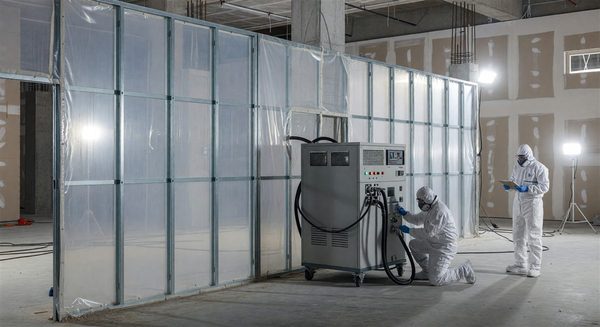
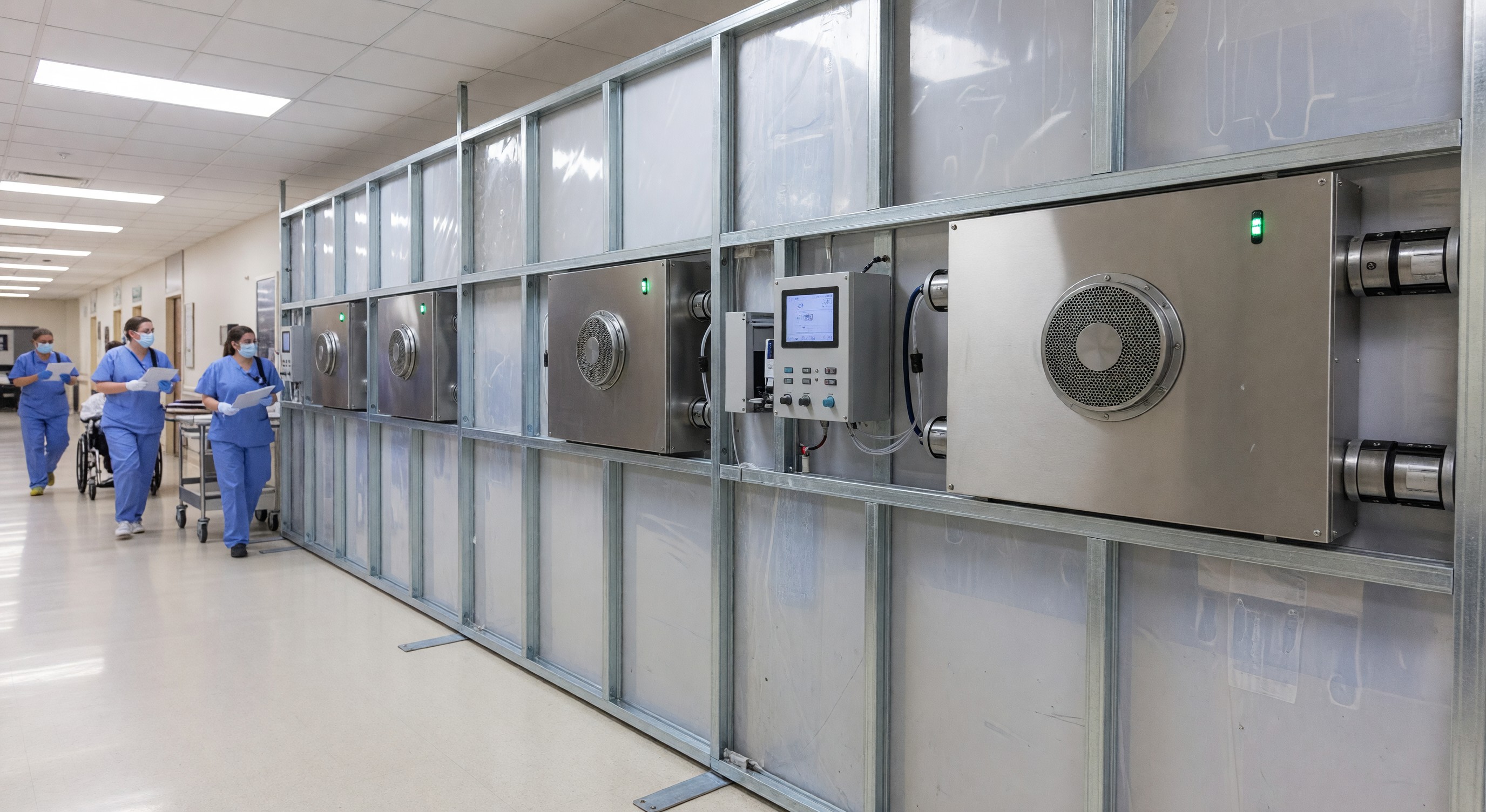
The physical barrier between construction and patient care areas is the primary engineering control for construction-related infection prevention. Effective barriers require:
Airtight Construction Conventional drywall partitions with taped and sealed joints provide the most reliable dust control. Plywood panels with foam sealer at wall, floor, and ceiling interfaces are common for temporary barriers. The barrier must extend from floor to deck above the suspended ceiling (not just from floor to suspended ceiling), as the plenum space is shared with HVAC return air.
Negative Pressure Maintenance The construction zone must be maintained at negative pressure relative to adjacent patient areas. This is achieved through temporary exhaust fans that pull air from the construction zone and exhaust it through HEPA filters to the exterior (never into the patient area HVAC return). Pressure differential monitors should be installed to verify continuous negative pressure and alarm when the differential is lost.
Access Control The only people who should enter the construction zone are essential construction workers. Workers should don appropriate PPE before entry and remove it in a defined doffing area before entering clean areas. All materials entering and leaving the zone should pass through controlled openings, and dusty materials should be bagged before removal.
HVAC Isolation HVAC supply and return registers within the construction zone must be temporarily sealed to prevent construction dust from being pulled into the hospital HVAC system or positive supply pressure from the hospital system from undermining construction zone negative pressure.
Pre-Construction ICRA Planning
An ICRA is conducted before construction begins and includes:
Site Walk The ICRA team—typically including the facilities director, infection preventionist, and project manager—walks the proposed project area and all adjacent patient care spaces to understand the risk context.
Traffic and Logistics Review Planned worker entry routes, material delivery paths, and waste removal routes must avoid patient care areas as much as possible. Construction worker break areas, tool storage, and staging areas must be positioned to minimize patient area intersections.
HVAC Review The project engineer must map the HVAC systems serving both the construction zone and adjacent patient areas to determine required isolation measures and verify that construction-zone exhaust can be routed to the exterior without recirculation.
Patient Census Consideration For projects adjacent to highest-risk patient populations, the ICRA planning may include consideration of census management—temporarily relocating the highest-risk patients during the highest-dust-generating construction phases if physical barriers cannot provide sufficient protection.
Ongoing ICRA Monitoring During Construction
ICRA is not a one-time pre-construction activity. Effective construction infection control requires ongoing monitoring throughout the project:
Daily Walk-Through A member of the facilities or infection prevention team should walk the construction barriers, check negative pressure monitors, and observe work activities daily during active construction. Barrier integrity issues, negative pressure failures, and worker compliance problems are discovered and corrected through daily monitoring.
Environmental Air Sampling In projects adjacent to highest-risk patient populations, environmental air sampling in patient areas provides objective verification that construction activities are not generating Aspergillus or other mold spores in patient spaces. Sampling protocols should be established in the ICRA plan and samples reviewed by infection prevention professionals.
Contractor Training and Communication Construction workers must understand why infection control measures matter in healthcare settings. Pre-construction ICRA training for all workers entering the facility, with reinforcement from daily monitoring, is essential for consistent compliance.
ICRA Documentation for Joint Commission Compliance
The Joint Commission EC.02.06.01 standard requires that healthcare organizations conduct risk assessments prior to construction and renovation activities and take steps to prevent infections during these activities. ICRA documentation that surveyors expect to see includes:
- Written ICRA for each active construction project
- ICRA team composition (with infection prevention representation)
- Risk classification determination with supporting rationale
- Required control measures documentation
- Evidence of ongoing monitoring (daily logs, negative pressure records, air sample results if applicable)
- Corrective action documentation for any identified compliance failures
Frequently Asked Questions
Who should be on the ICRA team? The ICRA team typically includes the infection preventionist, the facilities project manager, the architect or project engineer, a representative from the affected clinical area, and the general contractor’s site supervisor. Safety and risk management representation is valuable for larger projects. The infection preventionist’s involvement is critical—the ICRA exists specifically to integrate infection prevention expertise into the construction process.
What happens if a construction-related infection is suspected? Suspected construction-related infections should trigger immediate notification of the infection prevention team and, depending on the clinical severity, public health authorities. The response includes enhanced environmental sampling in both the construction zone and patient areas, review of ICRA barrier integrity and pressure monitoring records, and consultation with clinical leadership about patient risk management. Construction activities may be temporarily suspended pending assessment.
Do ICRA requirements apply to routine maintenance activities like replacing ceiling tiles? Yes, though at a lower risk classification. Even routine maintenance activities that require disturbing ceiling tiles or penetrating barriers adjacent to patient care areas should be assessed against the ICRA risk matrix. In areas with high-risk patients (oncology, transplant), even ceiling tile replacement requires ICRA-specified precautions.
How does ICRA planning change when construction is in a fully occupied patient floor? Construction in occupied patient floors represents the most challenging ICRA scenario. When full floor decanting is not possible, the ICRA plan must address the proximity of the highest-risk patients to construction activity, the sufficiency of physical barrier separation, the reliability of negative pressure maintenance in a complex HVAC environment, and the clinical management plan if barrier integrity is compromised. For the highest-risk patient populations (transplant, NICU), the preferred approach is decanting the entire floor during the highest-risk construction phases.