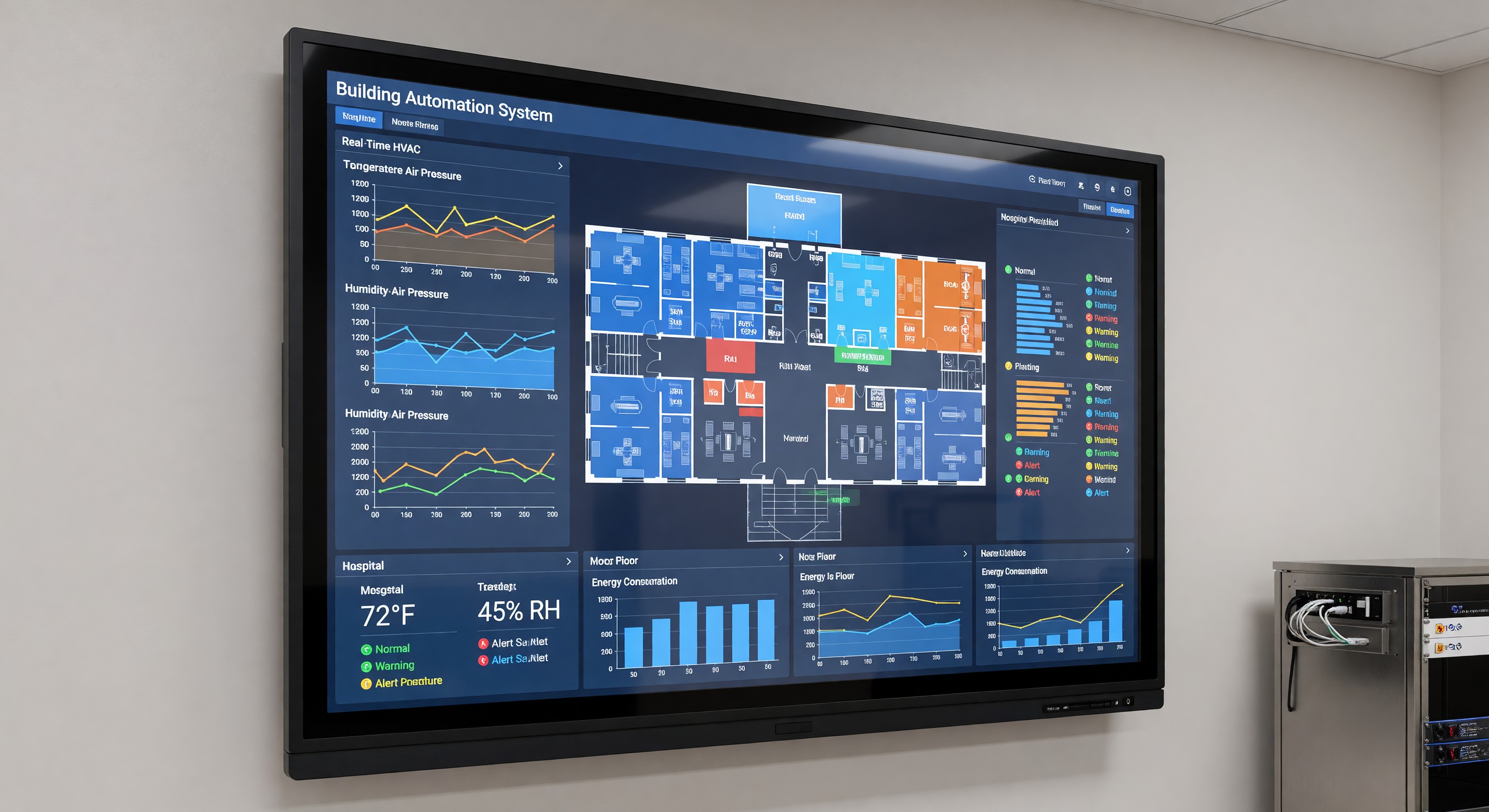
Hospital building automation systems (BAS)—also called building management systems (BMS)—are the central nervous system of healthcare facility infrastructure. These integrated control platforms manage HVAC equipment, lighting, electrical distribution, medical gas monitoring, and life safety systems through a unified interface, giving facility management teams real-time visibility and control over the physical environment across entire campuses.
For facility directors managing large hospital campuses, BAS platforms have evolved from basic HVAC schedulers into sophisticated operational tools that directly support clinical quality, regulatory compliance, and energy management goals. Understanding the capabilities and limitations of modern healthcare BAS—and how to get more from existing infrastructure—is a core competency for senior facility management professionals.
Core BAS Functions in Healthcare
HVAC Control and Monitoring The primary BAS function in healthcare is continuous monitoring and control of HVAC systems to maintain required environmental conditions in clinical spaces. The BAS monitors temperature, humidity, and pressure differentials in operating rooms, isolation rooms, sterile processing areas, and laboratories—spaces where ASHRAE 170-2017 and other standards specify tight environmental parameters.
Modern healthcare BAS platforms collect continuous data streams from hundreds or thousands of sensors, applying setpoint control algorithms that maintain specified conditions while optimizing energy use. When conditions drift outside setpoint tolerances, the system generates alarms that alert facilities staff before clinical impacts occur.
Pressure Differential Monitoring Maintaining correct pressure relationships between spaces is critical in clinical environments. Operating rooms must maintain positive pressure relative to adjacent corridors. Airborne infection isolation rooms require negative pressure. Protective environment rooms for immunocompromised patients require positive pressure. The BAS continuously monitors pressure differentials and alerts staff when relationships drift outside acceptable ranges.
Joint Commission EC.02.06.01 and related standards require that healthcare facilities document environmental monitoring. BAS data logging provides the continuous documentation record that surveyors examine during Environment of Care inspections.
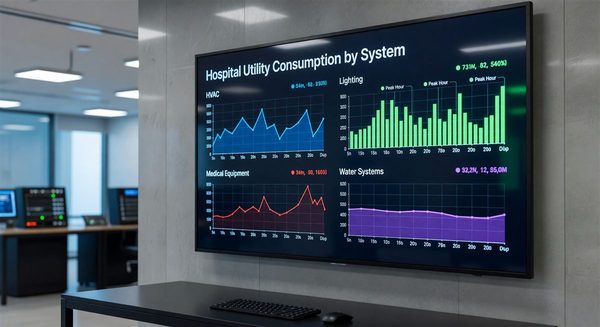
Energy Management Hospital campuses are among the most energy-intensive building types—energy costs per square foot run 2–5 times higher than commercial office buildings. BAS energy management functions include scheduling of HVAC systems to avoid running at full capacity in unoccupied areas, demand-limiting strategies that reduce electrical peak demand charges, and integration with utility demand response programs.
Healthcare campuses that have implemented sophisticated BAS energy management typically achieve 10–20% reductions in energy cost without compromising clinical environmental requirements.
Alarm Management BAS platforms in large hospitals generate thousands of alarms daily. Effective alarm management—prioritizing alarms by severity, routing alarms to the appropriate responders, suppressing nuisance alarms during planned maintenance—is critical for maintaining facilities team effectiveness. Poorly configured alarm systems generate “alarm fatigue” where important alerts are missed among the noise of excessive nuisance alarms.
ANSI/ISA 18.2 provides a recognized standard for alarm system design and management that healthcare facilities can apply to BAS alarm configuration.
Integration with Clinical Systems
Modern healthcare BAS platforms increasingly integrate with clinical and operational systems to provide contextual intelligence that pure facility data cannot:
Infection Control Integration Integration with infection surveillance systems allows the BAS to automatically flag environmental excursions (pressure differential failures, temperature setpoint violations) for correlation with infection investigation data. This supports outbreak investigation and provides documentation that environmental conditions are being maintained in compliance with infection control requirements.
OR Scheduling Integration Integrating the BAS with the operating room scheduling system allows HVAC setpoints to be automatically adjusted based on the OR schedule—bringing rooms to occupied setpoints in advance of scheduled procedures and allowing energy-saving setbacks during unscheduled periods—without requiring manual scheduling by facilities staff.
Maintenance Management Integration When the BAS integrates with the computerized maintenance management system (CMMS), equipment alarms can automatically generate work orders, and equipment runtime data can drive preventive maintenance scheduling. This closes the loop between monitoring and maintenance action.
Common BAS Deficiencies in Healthcare Facilities
Facility directors inheriting aging BAS infrastructure frequently discover specific deficiency patterns:
Orphaned Points Points configured in the BAS database for equipment that has been replaced, removed, or reconfigured—but never cleaned up in the BAS configuration. Orphaned points generate false alarms, consume display space on graphics pages, and can cause confusion during troubleshooting. Periodic BAS database cleanup is essential for effective operations.
Outdated Graphics BAS graphic display pages that don’t match current equipment configurations mislead operators and slow troubleshooting. Graphics should be updated whenever HVAC systems are modified, and periodic audits should verify that graphics accurately represent current system configurations.
Inadequate Sequence-of-Operations Documentation The BAS control logic—setpoints, sequences, control algorithms—should be fully documented and updated whenever programming is modified. Facilities teams that lose BAS programming documentation face significant reconstruction effort when control problems require investigation or system replacement.
Sensor Calibration Drift Temperature, humidity, and pressure sensors drift over time and require periodic calibration to maintain accuracy. Facilities without systematic sensor calibration programs may be operating on inaccurate data, making environmental compliance documentation unreliable.
BAS Cybersecurity in Healthcare Networks
Healthcare BAS platforms are increasingly networked and internet-accessible, creating cybersecurity risks that weren’t present in earlier isolated systems. HVAC systems at healthcare organizations have been exploited as entry points for broader IT network intrusions—the 2013 Target retail breach is a widely cited example of HVAC network compromise leading to broader data breach, and healthcare organizations have experienced similar attack vectors.
Key cybersecurity practices for healthcare BAS:
- Network segmentation between the BAS network and clinical IT networks
- Strong authentication for BAS workstation access (multi-factor authentication preferred)
- Vendor access controls for remote monitoring and support connections
- Regular firmware and software updates for BAS controllers and workstations
- Penetration testing of BAS infrastructure as part of the organization’s IT security program
NIST Cybersecurity Framework provides guidance applicable to operational technology environments like healthcare BAS systems. Organizations should work with IT security teams to develop a specific cybersecurity program for building automation infrastructure.
Upgrading Aging BAS Infrastructure
Many healthcare facilities operate BAS infrastructure that is 15–25 years old, with limited integration capability, poor energy management functionality, and increasing difficulty sourcing replacement parts. Planning BAS upgrades requires understanding the options:
Full Replacement Complete replacement of BAS controllers, workstations, and integration infrastructure delivers maximum capability but requires significant capital investment and typically involves extended commissioning periods. Full replacement is appropriate when existing systems can no longer be cost-effectively maintained.
Control Layer Upgrade with Retained Field Devices Replacing BAS servers, workstations, and controllers while retaining field devices (sensors, actuators, dampers) can significantly reduce upgrade cost while modernizing the control and monitoring capabilities that most affect operations.
Open Protocol Migration Legacy BAS systems using proprietary communication protocols can often be migrated to open protocols (BACnet, Modbus) that enable integration with current-generation systems without complete hardware replacement. This approach preserves existing field infrastructure while enabling integration with modern analytics and management platforms.
Frequently Asked Questions
What BAS documentation should healthcare facilities maintain for Joint Commission compliance? Key documentation includes: current BAS point lists with setpoint parameters and alarm thresholds, control sequences of operations for all major HVAC systems, calibration records for environmental sensors, alarm response logs, and BAS training records for facilities staff. This documentation should be organized for rapid retrieval during surveys.
How should healthcare facilities prioritize BAS investment when full replacement isn’t feasible? Prioritize investment in areas with the highest clinical impact: operating room environmental monitoring, isolation room pressure differential monitoring, and sterile processing and laboratory environmental controls. These areas have both the highest regulatory compliance stakes and the highest patient care impact from environmental excursions.
What’s the typical lifecycle for hospital BAS infrastructure? BAS software platforms are typically supported for 10–15 years before reaching end-of-life. Hardware controllers have similar lifecycles, though some legacy systems remain operational far beyond nominal support periods. Healthcare organizations should budget for BAS replacement on 15–20 year cycles and begin planning replacement when systems approach 12–15 years of age to allow adequate time for specification, procurement, and implementation.
How are cloud-based BAS platforms changing healthcare facility management? Cloud-based BAS platforms and analytics services are enabling fault detection and diagnostics, multi-campus energy management benchmarking, and remote monitoring capabilities that weren’t feasible with traditional on-premises BAS architectures. Healthcare facility organizations with multiple campuses are finding particular value in centralized monitoring platforms that provide system-wide visibility without requiring dedicated BAS engineering staff at each location.