Steam systems in hospitals are among the oldest and most consequential building infrastructure in healthcare. Hot water and steam provide space heating, domestic hot water, humidification, and — critically — the energy source for autoclave sterilization in sterile processing departments. A major steam system failure in winter or during a critical sterilization period is a patient safety emergency.
Managing boiler and steam systems in healthcare requires technical competency, regulatory compliance, and the institutional knowledge that comes from understanding the specific quirks of aging steam infrastructure.
Steam System Functions in Healthcare
Space heating — Many hospital campuses use steam or hot water distribution for building space heating, particularly in facilities with significant existing steam infrastructure. Large campus chilled water and steam loops serve multiple buildings from a central utility plant.
Domestic hot water — Steam heat exchangers produce domestic hot water at the volumes and temperatures required in healthcare facilities (maintained at 140°F+ for Legionella prevention, tempered to 120°F at point of use).
Humidification — Medical-grade HVAC humidification systems typically use steam injection for precise, reliable humidity control in clinical spaces.
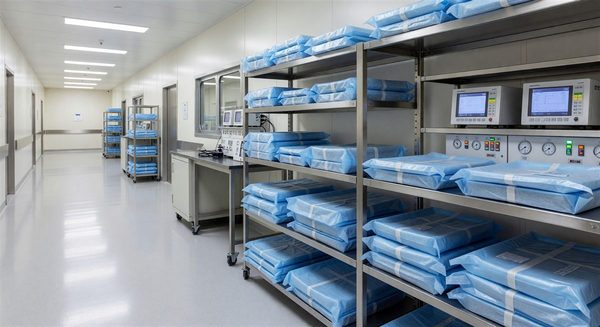
Sterilization — Autoclave sterilizers require clean steam at defined pressure and quality. Steam quality (superheat, dryness fraction, chemical purity) must meet AAMI TIR34 requirements for healthcare sterilization applications.
Dietary — Food service operations use steam for cooking equipment, steam kettles, and dishwashing systems.
ASME Boiler Code Requirements
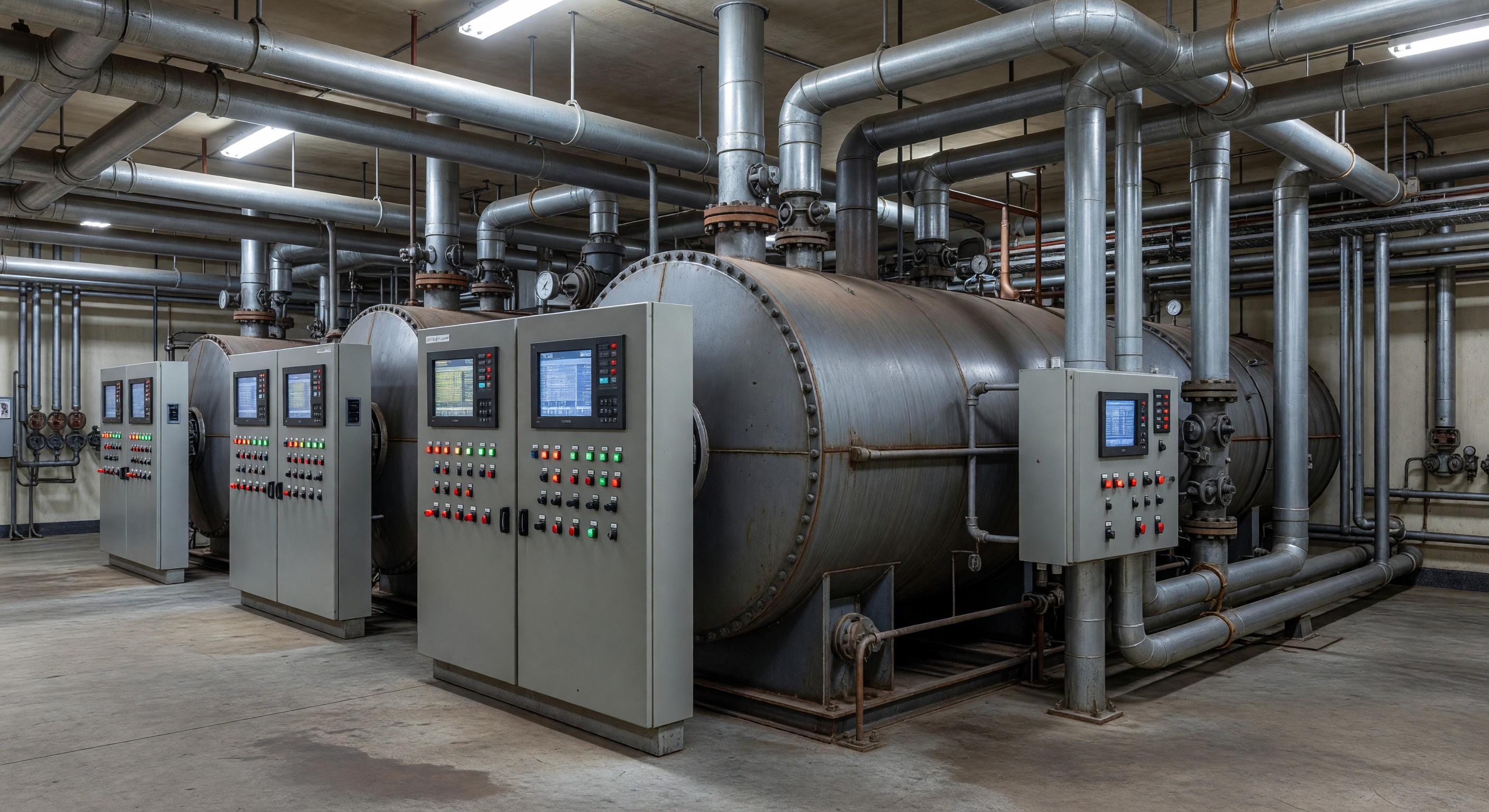
The ASME Boiler and Pressure Vessel Code (BPVC) Section I (Power Boilers) and Section IV (Heating Boilers) govern the design and construction of boilers. All states have adopted the ASME BPVC by reference in their boiler safety regulations, which establish inspection, operator licensing, and operating requirements.
State boiler inspection — All boilers must be inspected by a state-licensed boiler inspector or an insurance carrier inspector authorized by the state. Inspection frequency varies by state and boiler classification but is typically annual for power boilers. Current inspection certificates must be posted in the boiler room. Operating a boiler with an expired inspection certificate is a violation with potential for immediate shutdown.
Boiler operator licensing — Many states require that boilers above specified horsepower be operated by licensed boiler operators. The license class (first-class engineer, second-class engineer, boiler operator) required depends on the boiler pressure and horsepower. Healthcare facilities must confirm that all boiler operators hold the license class required by state law.
Safety valve testing — Pressure relief (safety) valves on boilers must be tested annually per ASME code requirements. Safety valves that do not pop open at the rated pressure or that leak at operating pressure must be replaced immediately.
Steam Quality for Healthcare Applications
Not all steam is suitable for healthcare applications. Steam used in humidification that enters patient breathing zones, and steam used in autoclave sterilizers that contacts surgical instruments, must meet quality standards defined by AAMI TIR34:
Purity requirements — Steam used in sterilizers must not contain chemical additives (from boiler water treatment programs) that could contaminate sterilized instruments. The boiler water treatment program must use only AAMI TIR34-listed approved chemicals.
Superheat limits — Superheated steam (steam above saturation temperature at the given pressure) does not condense as readily on instrument surfaces, affecting sterilization efficacy. AAMI TIR34 specifies maximum superheat limits for sterilizer steam.
Non-condensable gases — Air and other non-condensable gases in steam interfere with steam penetration in autoclave loads. Steam supply for sterilizers must minimize non-condensable gas content through proper steam production and distribution design.
Dryness fraction — Wet steam (steam carrying liquid water droplets) can affect sterilizer load drying and package integrity. Dryness fraction requirements for sterilizer steam must be met.
Steam quality testing per AAMI TIR34 should be performed at installation and periodically thereafter, particularly following any significant boiler or steam distribution modification.
Distribution System Management
Hospital steam distribution systems — particularly those on large campuses with multiple buildings — are complex piping networks with significant maintenance requirements:
Steam traps — The most frequently failing component in steam distribution systems. Steam traps separate condensate from steam, discharging condensate while retaining steam. Failed steam traps (failed open) waste significant energy. A survey of steam traps annually identifies failures for repair, with energy savings that can be substantial.
Condensate return — Return of condensate to the boiler conserves both water and the energy invested in water treatment. Condensate return systems (pumps, tanks, piping) require regular maintenance. Condensate that cannot be returned must be replaced with treated makeup water, increasing chemical and energy costs.
Insulation — Steam piping insulation is critical for both energy efficiency and safety. Deteriorated or missing insulation increases heat loss, condensate formation, and burn risk from exposed hot surfaces. Inspect insulation annually and replace deteriorated sections.
Pressure reducing valves (PRVs) — Many hospital systems reduce high-pressure steam from the boiler to lower pressures for distribution to specific applications. PRVs require periodic calibration and replacement when they fail to maintain accurate set pressure.
Preventive Maintenance Schedule
Daily — Water level verification, operating pressure check, blowdown per established frequency, feedwater system operation check, and operator log entries.
Monthly — Safety valve test (manual lift test), low water cutoff function test, gauge verification.
Annual — Full ASME-required inspection, safety valve pop test, water column cleaning, internal inspection, burner and combustion efficiency testing, chemical treatment program review.
Tri-annual — Hydrostatic pressure testing for boilers meeting specific criteria.
Frequently Asked Questions
What is the difference between a power boiler and a heating boiler? ASME defines power boilers as those operating above 15 psi steam pressure or generating steam intended for use externally to the boiler. Heating boilers operate at 15 psi or less (steam) or 160 psi or less (hot water). Power boilers have more stringent design, inspection, and operator qualification requirements. Most hospitals have power boilers for high-pressure steam used in sterilization and campus distribution.
What causes water hammer in steam systems and how is it prevented? Water hammer — the loud banging that occurs in steam piping — is caused by steam contacting subcooled condensate, producing rapid condensation that collapses with a pressure wave. Causes include: inadequate steam trap function (allowing condensate to accumulate), improper system startup that drives steam into a condensate-filled pipe, and poorly sloped piping that prevents condensate drainage. Prevention includes proper piping slope to drain toward traps, functioning steam traps, and slow startup procedures that allow condensate to be removed before high-pressure steam flow.
How do we evaluate whether our aging boilers should be replaced or maintained? Evaluate based on: age relative to ASME design life (most fire-tube boilers are designed for 20–30 years of service), current efficiency versus modern equipment (older boilers may operate at 75–80% efficiency; modern condensing boilers achieve 90%+), maintenance cost trend, reliability history, and refrigerant/fuel consideration if the heating fuel may change. A lifecycle cost analysis comparing 10-year maintenance and energy costs for existing equipment versus capital and operating costs for new equipment typically supports replacement for equipment over 20 years old.
What happens if a boiler fails during winter in a cold climate hospital? Activate the emergency utilities plan: portable electric space heaters in patient areas, temporary heating equipment rentals if the outage will be extended, and patient relocation assessment if temperatures cannot be maintained. Contact the boiler service contractor for emergency response. Consider patient diversion for elective admissions until heat is restored. Pre-positioned emergency heating contracts before winter season are advisable in cold climates.