Two regulatory tracks are converging on the hospital front door, and facility directors in California are on a shorter clock than the calendar suggests.
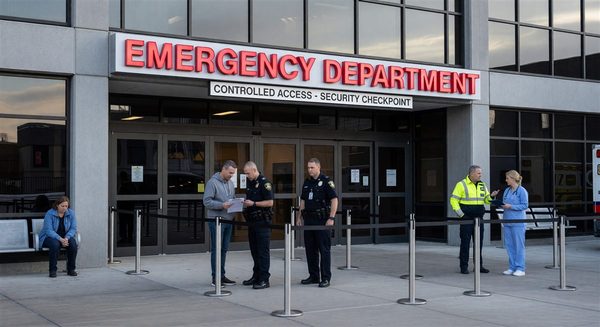
Track one: AB 2975, signed into California law in September 2024, amends Labor Code Section 6401.9 to require automated weapons detection screening at specified hospital entrances — the main public entrance, the emergency department entrance, and the labor and delivery entrance where it has a separate public entrance. The law directs the Cal/OSHA Standards Board to finalise the compliance standards by March 1, 2027, after which hospitals have 90 days to reach full compliance.
Track two: NFPA has been processing a tentative interim amendment, TIA 1869, to resolve whether weapons detection equipment installed in a required means of egress constitutes an obstruction under NFPA 101, the Life Safety Code. The amendment affects sections of the 2012, 2024, and proposed 2027 editions, and went out for public comment with a March 5, 2026 deadline.
The interaction between them is the whole story. A California hospital could install a compliant screening system and create a Life Safety Code violation at the same entrance — and because CMS Conditions of Participation reference NFPA 101, that violation reaches accreditation and reimbursement, not just the fire marshal.
Why a screening checkpoint is an egress problem
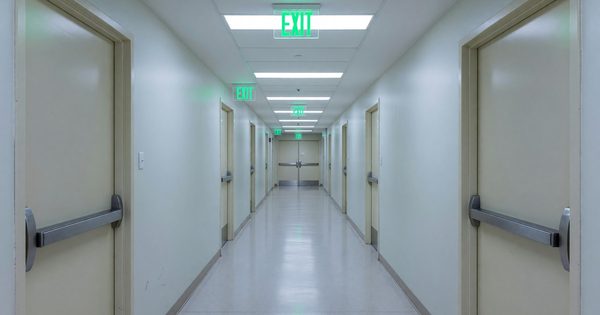
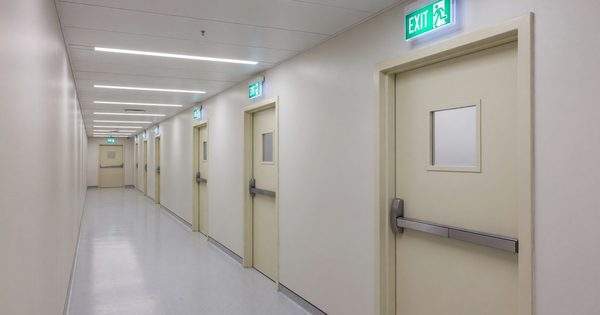
The main public entrance of a hospital is a required exit. Its capacity is calculated, its clear width is specified, and anything placed in it that reduces effective width or creates a queue reduces the building’s ability to discharge occupants.
A weapons detection portal is physically not much — two pedestals and a gap. The problem is everything around it: the queue that forms in front, the secondary screening table beside it, the bag-check station, the staffing position, and the stanchions that organise the line. Hospital administrators raised exactly this concern as the California mandate advanced, and it is the right concern. An entrance that functions on a normal Tuesday can fail badly during the event that triggers evacuation — which, in a hospital, is often the same event that brought people to the entrance in the first place.
TIA 1869’s clarification is that weapons detection systems at health care facility entrances, whether permanently installed or mobile, do not constitute obstructions to paths of egress, and should be treated the way the code already treats turnstiles, vestibules, and exit doors. ASHE’s regulatory affairs staff worked with the NFPA 101 technical committee on the language specifically to resolve the enforceable conflict.
That is a meaningful clarification, and it is not a blanket exemption. The existing code treatment of turnstiles and vestibules carries conditions — capacity limits, clear width, failure mode, and the ability for the arrangement to be defeated in an emergency. Screening equipment gets the same framework, not an exit from it.
The design questions that actually decide compliance
Three decisions determine whether a screening deployment passes both reviews.
Where the queue forms, and whether it is inside the egress path. The portal itself may be permitted; a forty-person line in the exit discharge is a different question. The design answer is almost always to create dedicated queue space outside the calculated egress width — a vestibule extension, a canopy, a reconfigured lobby — rather than to consume the lobby. This is the item most likely to convert a security project into a construction project, and the reason the capital number usually exceeds the equipment quote by a wide margin.
What happens on failure and on evacuation. The system needs a defined behaviour when the building goes into alarm: screening suspends, staffing clears the equipment from the path if it is mobile, and the full egress width is restored. That behaviour needs to be written into policy, practised in drills, and documented — because an inspector will ask, and because it is the actual safety question underneath the code question.
Emergency department entrance, specifically. The ED entrance is the highest-risk screening point and the hardest to design, because it takes ambulance arrivals, walk-in patients in distress, and law enforcement, often simultaneously. Screening that delays a walk-in cardiac patient is a clinical problem that no code addresses. Most workable designs separate the ambulance path entirely from the screened walk-in path and staff the ED checkpoint to bypass on clinical judgement.
Meeting the mandate without the capital surprise
California hospitals have a defined window and a defined scope, and the scope is narrower than it is often reported — three entrance types, not every door. The scoping exercise worth doing now, before Cal/OSHA’s standard is final:
Identify the entrances in scope at each facility, and confirm whether labor and delivery has a separate public entrance. Then measure the existing egress width and capacity at each and calculate what remains after equipment and queue. That number tells you which entrances are equipment purchases and which are construction projects, and the difference between those two is typically an order of magnitude.
Consolidate public entrances where you can. Hospitals accumulate doors, and every additional public entrance is either a screening point or a bypass that defeats the screening. Reducing the number of public entrances before the standard lands is the single largest cost reduction available, and it is an operational decision rather than a capital one.
Plan the staffing. Automated detection reduces false positives relative to walk-through metal detectors but does not eliminate secondary screening, and the labour line is recurring where the equipment is not. For a 24/7 ED entrance, staffing typically exceeds the amortised equipment cost within the first year or two.
For hospitals outside California
The California statute does not bind you and the NFPA 101 amendment does. TIA 1869 applies to health care occupancies generally, which means any hospital considering weapons screening — and many are, driven by workplace violence rather than by statute — now has a clearer code pathway than existed eighteen months ago.
It also means the reverse: a screening deployment installed before this clarification, without an egress analysis, is worth revisiting. The equipment may be fine. The queue, the secondary table, and the stanchions that appeared around it over the following year are what a surveyor will measure.