Hospital data centers house the servers, storage systems, and networking infrastructure that support electronic health records, clinical applications, and the entire digital backbone of patient care. A physical security failure at the data center — unauthorized access, environmental incident, or power failure — can disrupt clinical operations across the entire facility.
Physical security of the data center is a shared responsibility between IT, facilities, and security departments. Facility directors own the physical environment: the room construction, environmental systems, fire suppression, and access control infrastructure. Understanding how these elements support data center security and reliability is essential for comprehensive protection.
Physical Access Control
Entry Control Design
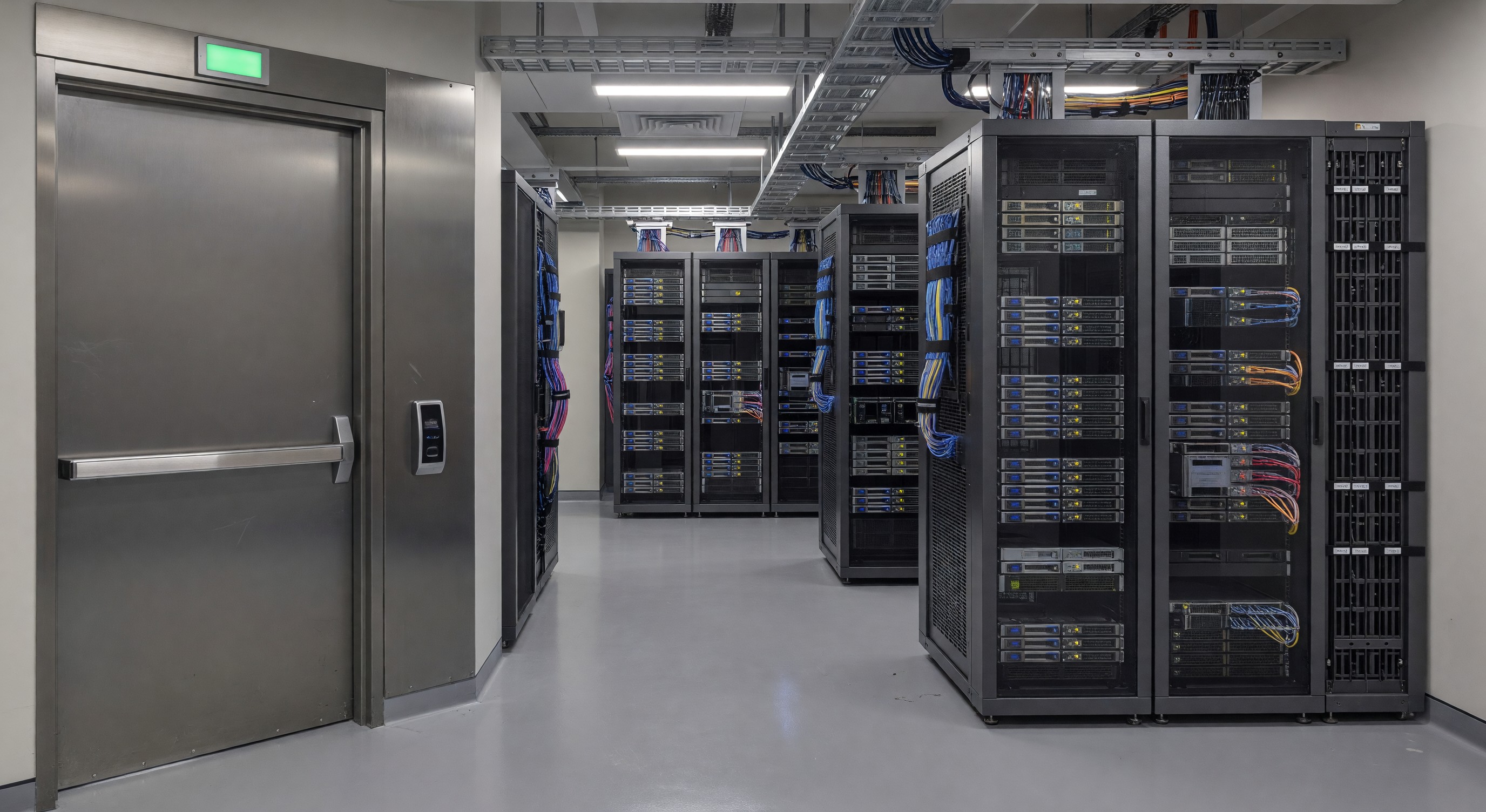
Hospital data centers should implement multi-factor access control at entry points:
- Badge plus PIN: Requiring both a proximity credential and a PIN prevents unauthorized access if a badge is lost or stolen
- Biometric authentication: Fingerprint, iris, or facial recognition adds a third authentication factor for the highest-security data center environments
- Video at entry: Camera coverage of the data center entry door captures all access events with visual confirmation of the individual
- Mantrap vestibule: A double-door entry that allows only one person to enter at a time prevents tailgating (unauthorized individuals following an authorized person through the door)
Access rights to the data center should be limited to authorized IT staff, facilities personnel with valid maintenance needs, and approved vendors. Access lists should be reviewed at least quarterly and rights terminated immediately when personnel separate from the organization.
Interior Zone Control
Large data centers may further segment access within the facility:
- Cage or cabinet locks: Individual server cabinets with keyed or electronic locks restrict access to specific systems within the data center to personnel with legitimate need
- Camera coverage within the data center: Cameras positioned to cover cabinet rows and work areas provide audit capability for all activity within the data center
- Visitor escort policy: All visitors (vendors, auditors, contractors) must be escorted by authorized staff at all times within the data center
Access Logging and Audit
All access events should be logged with individual identity and timestamp. These logs:
- Support investigation of unauthorized access incidents
- Provide documentation for HIPAA Security Rule compliance (required administrative and technical safeguards for ePHI systems)
- Enable after-action analysis following incidents or outages
- Support Joint Commission EC.02.05 documentation requirements for utility systems (including IT infrastructure systems)
Environmental Monitoring
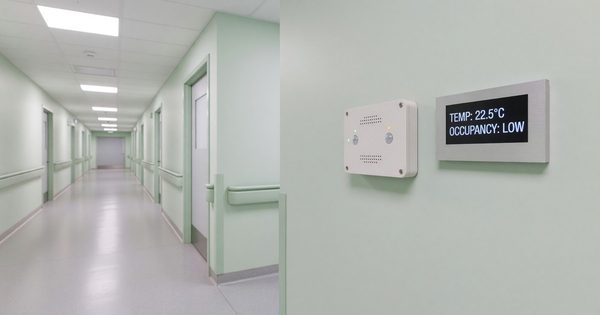
Data center equipment — servers, storage, networking — is sensitive to temperature, humidity, and water intrusion. Environmental monitoring systems provide:
Temperature monitoring: Sensors at multiple points within the data center (particularly hot aisle/cold aisle monitoring) alert immediately when temperature rises above threshold. Typical server rooms operate at 65-80°F with specific airflow design for hot/cold aisle containment.
Humidity monitoring: Both excessive humidity (condensation risk) and low humidity (static electricity risk) are harmful. Maintaining 40-60% relative humidity protects equipment and prevents electrostatic discharge.
Water intrusion detection: Leak detection sensors under raised floors and at vulnerable locations (below pipe penetrations, near HVAC condensate drain pans) alert before water can damage equipment.
Power quality monitoring: Voltage, frequency, and power quality monitoring detects utility power anomalies before they cause equipment damage or UPS failures.
Environmental monitoring alerts should be routed to the facilities operations center and IT operations center simultaneously, with defined escalation procedures for each alert type.
Power Protection Infrastructure
Uninterruptible Power Supply (UPS)
All critical IT equipment in the hospital data center must be protected by UPS systems that provide:
- Runtime during power transfer: UPS bridges the gap between utility power failure and generator transfer (typically 10-30 seconds per NFPA 99 requirements)
- Voltage regulation: UPS provides clean, regulated power to sensitive electronic equipment
- Battery maintenance: UPS batteries require periodic load testing (typically annually) and replacement on a defined cycle (typically every 4-5 years for VRLA batteries)
Generator Backup
The data center must receive power from the essential electrical system (EES) per NFPA 99, ensuring generator backup during utility power failures. The IT equipment branch of the EES should be properly sized for the full data center load.
Power Distribution Redundancy
High-availability data centers use redundant power distribution — dual-corded servers connected to separate PDUs (power distribution units) fed from separate UPS and generator circuits. If one power path fails, the other maintains equipment operation without interruption.
Fire Suppression
Hospital data centers require fire suppression systems appropriate for electronic equipment:
Clean agent suppression: FM-200 or Novec 1230 clean agent systems suppress fire without water damage and are appropriate for occupied data centers where server equipment is active. NFPA 2001 governs clean agent systems.
Pre-action sprinkler: Some data centers use pre-action dry pipe sprinkler systems that require both a heat detector and a sprinkler activation before water is released — reducing the risk of accidental water discharge from a damaged sprinkler head.
Avoidance of wet pipe sprinklers: Wet pipe sprinklers in data centers risk catastrophic equipment damage from accidental activation. If wet pipe sprinklers are present in an existing data center, migration to a clean agent or pre-action system should be a capital priority.
HIPAA and Regulatory Compliance
The HIPAA Security Rule requires covered entities to implement physical safeguards for electronic protected health information, specifically:
- Facility access controls: Limiting physical access to electronic information systems to authorized users
- Workstation use and security: Physical safeguards for workstations that access ePHI
- Device and media controls: Procedures for hardware and media movement and disposal
Data center physical security directly satisfies the HIPAA physical safeguard requirements for the servers and infrastructure housing ePHI. Documentation of access control policies, access logs, and environmental monitoring programs should be included in the HIPAA Security Rule risk management program.
Frequently Asked Questions
Is a dedicated data center room required, or can servers be placed in telecommunications rooms? Servers and critical IT infrastructure can be housed in telecommunications rooms, but dedicated data center rooms with appropriate access control, environmental monitoring, fire suppression, and power protection are preferred for high-availability systems. Placing servers in telecommunications rooms without data-center-level environmental protection creates reliability risk.
Who is responsible for data center physical security — IT or facilities? Physical access control, environmental systems, fire suppression, and power infrastructure are facilities responsibilities. IT is responsible for the technology within the data center and the logical security of systems. Security provides the access control platform and monitors physical access logs. Effective data center physical security requires all three departments working together with defined roles and responsibilities.
What environmental monitoring is required under Joint Commission standards? Joint Commission EC.02.05.01 requires management of utility systems that support patient care. IT infrastructure supporting clinical systems falls within the utility management scope. Environmental monitoring documentation — temperature logs, humidity logs, alert histories and responses — should be maintained as part of the utility management program and available for Joint Commission survey.
How often should data center UPS batteries be replaced? Lead-acid (VRLA) UPS batteries typically require replacement every 4-5 years under normal operating conditions. High-temperature operating environments accelerate battery aging. Annual load testing under rated UPS load is the best way to identify batteries approaching end-of-life before a failure occurs. Lithium-ion UPS batteries have longer service lives (10+ years) but higher upfront cost.