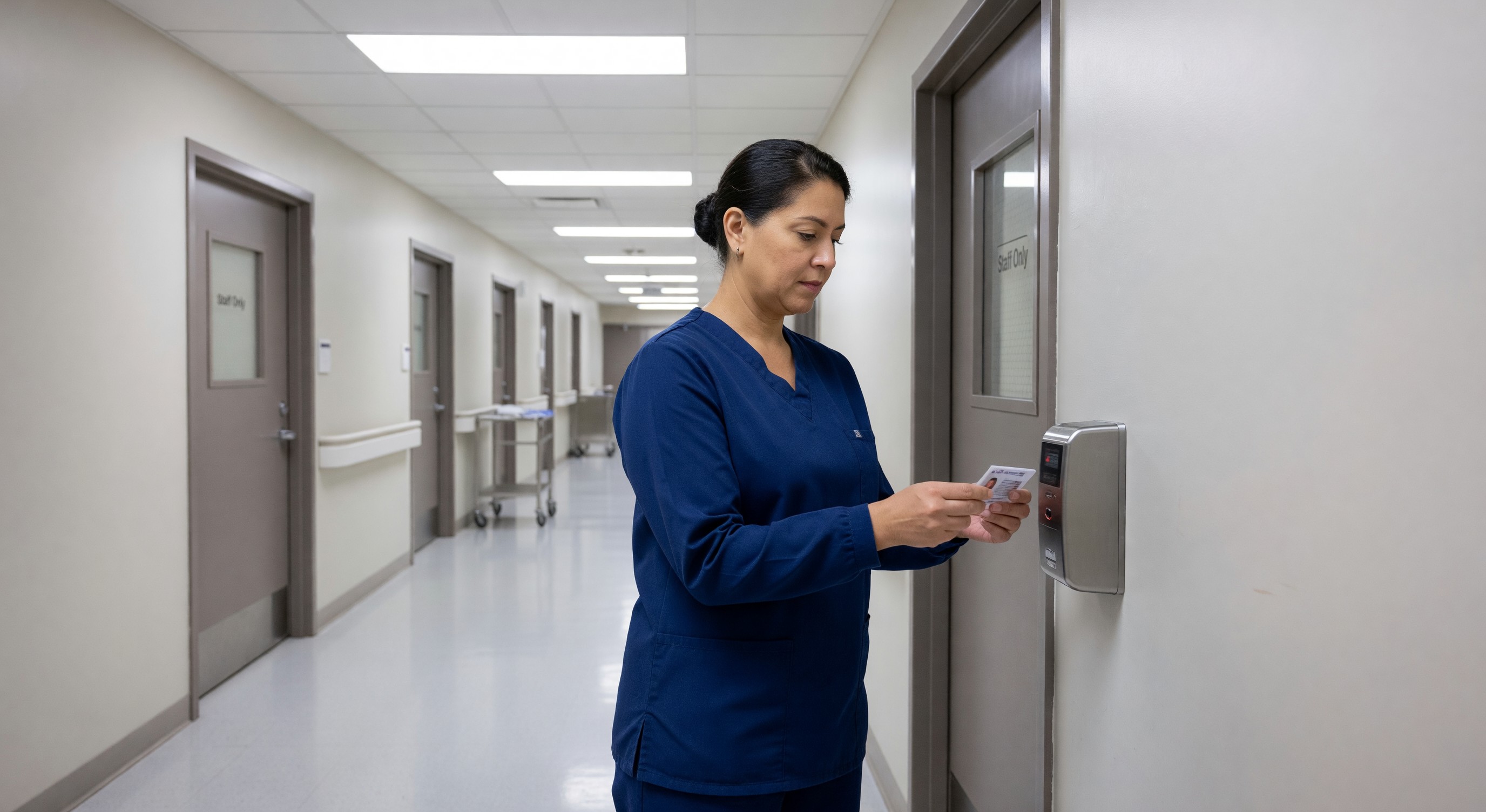
Badge-based access control is the connective tissue of healthcare facility security. It determines who can enter the pharmacy, who can reach the neonatal ICU, who can access the data center that hosts patient records, and who — critically — cannot. For VP of Facilities and security directors, the access control system is among the most consequential infrastructure investments on campus.
Getting it right requires understanding both the technology and the operational workflows that badge systems must support in a 24/7 clinical environment.
Healthcare Access Control Is Not Like Commercial Access Control
Office buildings and retail environments use access control to manage business hours and protect assets. Healthcare access control does all of that and more — it must also protect vulnerable patients, secure controlled substances, enable emergency lockdown, and support Joint Commission Environment of Care standards.
The regulatory overlay alone distinguishes healthcare from commercial applications:
- The Joint Commission EC.02.06.01 requires that the hospital establishes and maintains a secure environment for staff, patients, and visitors
- DEA 21 CFR Part 1301 mandates controlled substance storage with access logs
- CMS Conditions of Participation reference security of patient areas
- HIPAA Security Rule — while focused on electronic protected health information, physical access to systems that store ePHI is a covered safeguard
A credential breach in a hospital is not simply a theft risk. It is a patient safety risk.
Zoning Strategy: The Foundation of Effective Access Control
Before selecting hardware, define your access zones. A typical acute care hospital has 6–10 distinct zone levels:
Public zones — lobbies, cafeterias, gift shops, main corridor arteries. No credential required. Open to all during operating hours; secured overnight.
General staff zones — clinical corridors, nursing units, administrative offices. Standard employee badge access.
Restricted clinical zones — pharmacies, blood banks, surgical suites, ICUs, sterile processing. Limited to credentialed clinical staff. Audit logging required.
High-security zones — server rooms, controlled substance vaults, psychiatric units, infant security areas. Dual-factor authentication, motion detection, and continuous audit trail required.
Utility and infrastructure zones — mechanical rooms, electrical switchgear, roof access, data closets. Facilities and engineering staff only.
External perimeter points — loading docks, after-hours entrances, parking structure connections. Variable access windows by credential class.
Document every access point in a zone map before system deployment. This map becomes the master credential matrix and the reference document for quarterly access reviews.
Credential Technologies in Healthcare
Modern healthcare campuses use several credential technologies, often in parallel:
Proximity cards (125 kHz) — The legacy standard. Inexpensive but easily cloned. Still common at lower-security zones in older facilities. Should not be used for restricted or high-security zones.
Smart cards (13.56 MHz — MIFARE, iCLASS, SEOS) — Encrypted credentials that resist cloning. The current standard for healthcare deployments. Higher cost per card but dramatically better security.
Mobile credentials — Smartphone-based access via Bluetooth or NFC. Increasingly adopted for staff convenience. Eliminates physical card issuance and loss. Requires device management and enrollment infrastructure.
Biometrics — Fingerprint, iris, or palm vein readers for highest-security zones. Common in pharmacies and data centers. Requires careful consideration of infection control (shared touch surfaces) and accommodation of staff who cannot use fingerprint scanners.
PIN keypads — Supplement card readers at controlled substance areas for two-factor authentication. Simple, reliable, requires good key management protocols.
Integration with HR and Identity Management
Access control systems that are not integrated with HR create a dangerous gap: terminated employees retain active credentials. In healthcare, this is a patient safety issue.
Best practice requires direct API integration between your access control platform and your HR information system (HRIS). When an employee is terminated or goes on extended leave:
- HR updates the employee record
- HRIS triggers an automated deactivation in the access control system
- Badge is blocked within minutes of separation
Without this integration, deactivation relies on a manual workflow that routinely fails — a former employee might retain access for days or weeks after termination.
Similarly, new employee provisioning should be role-driven. When HR creates a record with job classification “Registered Nurse — ICU,” the system should automatically provision the correct zone access for that role without requiring manual configuration by facilities staff.
COVID-19 and Access Control Reconfiguration (2020)
The pandemic required rapid reconfiguration of access control across most hospital campuses. Visitor restriction policies meant that lobby entrances needed to be secured that had previously been public access points. Screening checkpoints required access control for screeners and patients simultaneously.
Facilities teams that had cloud-managed access control systems were able to adjust access schedules and zone configurations remotely. Those with legacy on-premise-only systems required physical programming at each reader — a significant labor demand during an already stressful period.
Temporary credentials for surge staff, travel nurses, and volunteer screeners also strained provisioning workflows. Facilities and HR teams that implemented streamlined temporary credential programs emerged from the pandemic with improved processes.
Visitor Management Integration
Modern healthcare visitor management systems integrate directly with access control. A visitor who checks in at the lobby kiosk, presents ID, and receives a printed or mobile visitor badge can be granted time-limited access to specific floors without manual staff escort.
This integration supports:
- Automatic expiration of visitor credentials at end of authorized visit
- Denied-access alerts if a visitor attempts to enter an unauthorized zone
- Complete audit log of visitor access events for security review
- Sex offender registry and known offender screening at check-in
Audit Logging and Compliance Reporting
Every access event — successful entry, failed attempt, door held open, door forced — should be logged with timestamp and credential identifier. This log supports:
- Joint Commission Environment of Care compliance documentation
- DEA inspection readiness (controlled substance access logs)
- HR investigations of misconduct or theft allegations
- Post-incident forensic review
Retention requirements vary by zone. Controlled substance access logs should be retained for at least 2 years per DEA requirements. Security incident logs are typically retained for 5–7 years.
Frequently Asked Questions
How often should we audit who has access to restricted zones? Quarterly reviews are best practice for high-security zones such as pharmacies and controlled substance storage. Annual reviews are minimum acceptable for general restricted zones. Any organizational change — departmental restructuring, manager turnover — should trigger an immediate review of that group’s access rights.
What happens to access credentials during a mass casualty event or emergency? Your access control system should have a pre-configured emergency mode that can be activated by security or administration. Emergency modes typically open designated primary corridors to all credentialed staff and may lock certain zones automatically. Test and document your emergency access procedures in your Emergency Operations Plan.
How do we handle access for contracted maintenance vendors? Issue temporary credentials valid only for the specific access points and time windows required for the work. Never issue permanent credentials to contractors. Many facilities use a contractor management module within their access control platform that supports time-limited credential issuance tied to work order number.
What is the appropriate response when someone tailgates through a secured door? Policy should require staff to challenge tailgaters politely — this is a cultural expectation, not just a procedural one. Vestibule-style double-door airlocks (mantraps) physically prevent tailgating at highest-security zones. Video analytics can detect tailgating events and generate alerts for real-time response.