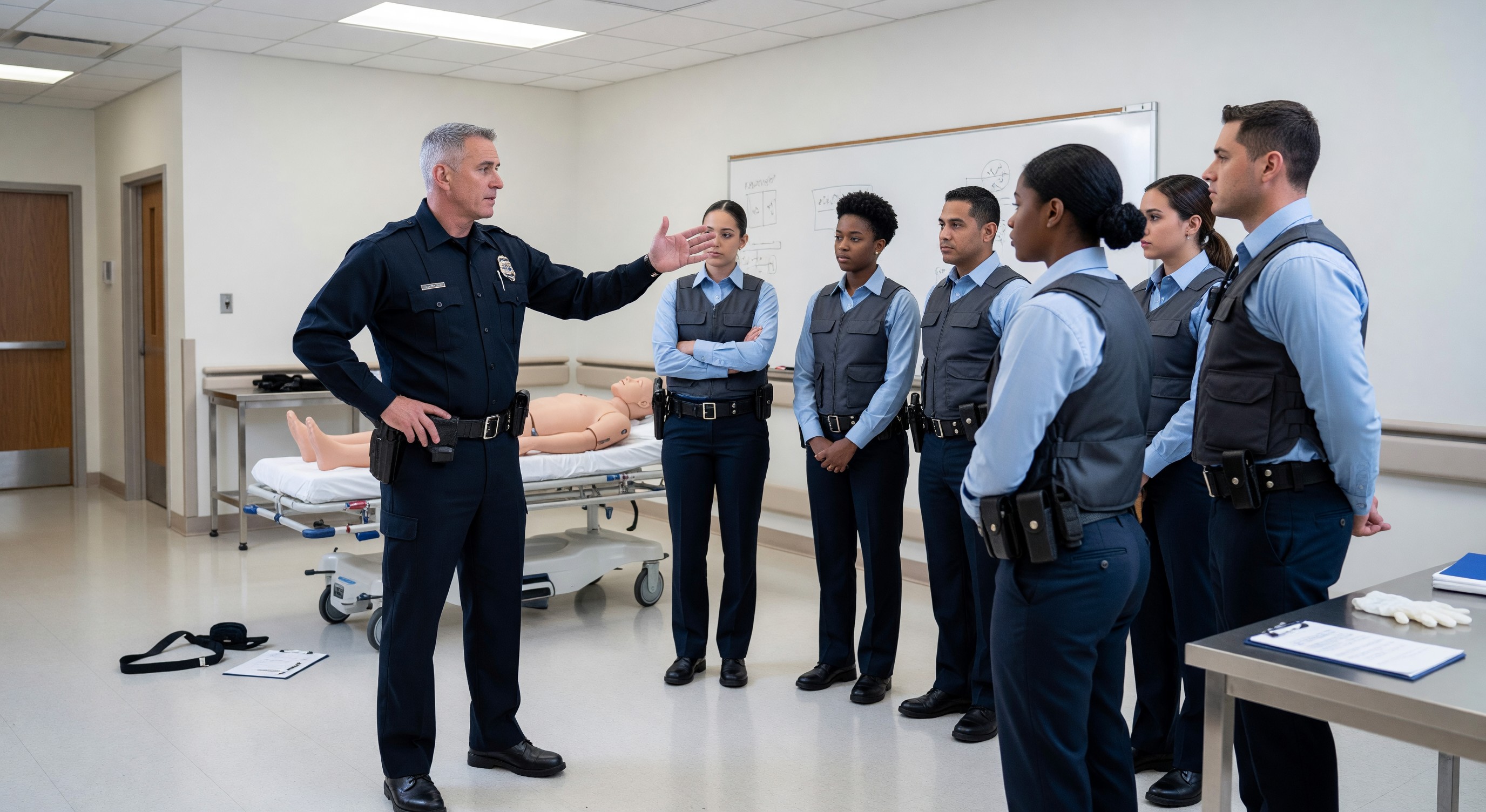
A well-designed physical security system is only as effective as the personnel operating it. Healthcare security officers face a unique professional environment — they must balance customer service, patient dignity, regulatory compliance, and use-of-force preparedness simultaneously. Without structured training, even the best-equipped security department will underperform.
The International Association for Healthcare Security and Safety (IAHSS) publishes the definitive training standards for the healthcare security profession. Facility directors and security managers should understand these standards and build training programs that meet or exceed them.
IAHSS Basic Training Standard
The IAHSS Basic Training Standard defines the minimum competency baseline for healthcare security officers. It covers 12 content areas:
- Roles and responsibilities of the healthcare security officer
- Legal aspects of healthcare security
- Communications and interpersonal skills
- Report writing
- Access control and key control
- Fire response
- Safety and the environment of care
- Emergency preparedness
- Infant and child abduction prevention
- Workplace violence prevention
- Hazardous materials awareness
- Patient rights and patient care team interaction
Officers should complete IAHSS Basic Training within their first 90 days of employment. Documentation of completion should be maintained in personnel files and auditable for Joint Commission survey purposes.
Advanced Certification Tracks
Beyond the Basic Training Standard, IAHSS offers several advanced credentials:
Certified Healthcare Security Supervisor (CHSS): For officers moving into supervisory roles. Covers security management, scheduling, performance evaluation, and incident command.
Certified Healthcare Protection Administrator (CHPA): The senior professional credential for security directors and managers. Requires significant experience and passing a comprehensive examination covering all aspects of healthcare security administration.
Certified Protection Officer (CPO): Offered through the International Foundation for Protection Officers (IFPO), this credential is widely recognized and complements IAHSS-specific training.
Encouraging staff to pursue certification improves retention, professional pride, and program quality. Some hospitals cover certification examination fees as an employment benefit.
De-escalation Training
Of all training content, de-escalation skills have the most direct impact on reducing physical confrontations and associated staff injuries and liability. Effective de-escalation training programs include:
Verbal intervention techniques: IAHSS recommends programs like Verbal Judo or CPI (Crisis Prevention Intervention) Nonviolent Crisis Intervention as foundational de-escalation curricula. These programs teach officers to redirect agitated individuals through tone, word choice, and body language.
Scenario-based practice: Tabletop scenarios or role-play exercises reinforce skills better than lecture alone. Scenarios should reflect actual situations officers encounter in the ED, behavioral health units, and parking areas.
Annual refresher requirements: De-escalation skills degrade without practice. Annual refresher training is the minimum; high-volume EDs may benefit from quarterly reinforcement.
Documentation of training: The Joint Commission’s EC.04.01.01 standard requires staff training as part of the security management plan. Training records must be maintained and available for survey review.
Use-of-Force Training
Healthcare security operates under a limited use-of-force model compared to law enforcement. Policies must balance patient rights, legal liability, and officer safety. Training components include:
Use-of-force policy review: Officers must understand the facility’s specific policy — where on the force continuum each response is authorized, documentation requirements, and supervisory notification procedures.
Physical intervention skills: Defensive tactics appropriate for healthcare settings — patient holds, escort techniques, and personal safety maneuvers — should be taught by certified instructors and practiced regularly.
Restraint awareness: While clinical staff manage patient restraints per CMS and Joint Commission restraint standards, security officers often assist. Training should cover appropriate roles, prohibited techniques, and patient monitoring requirements during security-assisted restraints.
Weapons policy: Most healthcare security departments are unarmed. Officers should be trained on prohibited item recognition, weapon confiscation protocols (if authorized), and coordination with law enforcement when firearms are involved.
Fire and Life Safety Training
Security officers serve as first responders to fire alarms and life safety events. Training must cover:
- RACE/PASS protocols (Rescue, Alarm, Contain, Extinguish / Pull, Aim, Squeeze, Sweep)
- Fire alarm panel operation and zone identification
- Evacuation procedures by unit type
- Coordination with the fire department on arrival
- Specific roles in the facility’s fire response plan under NFPA 101 and Joint Commission EC.02.03.01
Annual fire response drills — including unannounced exercises — should involve security staff and be documented.
New Employee Orientation Integration
Security training is most effective when integrated into the facility’s broader new employee orientation program. Key integration points:
- Joint Commission Environment of Care overview during general orientation
- Security-specific orientation scheduled within the first week of employment
- Unit-based orientation tours with security officers to familiarize new staff with emergency call points, duress systems, and access control procedures
This integration signals organizational commitment to security and establishes security officers as professional partners in the care environment.
Training Documentation and Competency Verification
The Joint Commission and CMS require documented evidence of competency — not merely attendance at training sessions. Best practices include:
- Written competency tests following training modules
- Skills checklists for physical intervention and equipment operation
- Annual competency re-verification
- Tracking in a learning management system (LMS) with automated renewal reminders
- Maintaining records for a minimum of three years (or as required by state law)
Training documentation should be reviewed before Joint Commission surveys and included in the security management plan annual evaluation.
Frequently Asked Questions
Is IAHSS Basic Training required by Joint Commission? The Joint Commission does not explicitly mandate IAHSS Basic Training by name. However, EC.04.01.01 requires that security staff be trained to fulfill their responsibilities, and IAHSS Basic Training is the recognized industry standard for meeting this requirement.
How many training hours per year are required for healthcare security officers? There is no single federal standard. IAHSS recommends a minimum of 40 hours annually for full-time officers. Many high-performing programs exceed this, particularly for officers assigned to high-risk areas like the ED or behavioral health units.
Should contract security officers receive the same training as employed officers? Yes. Contract security staff working in healthcare settings are subject to the same Joint Commission and CMS standards as directly employed staff. Training requirements should be specified in the service contract, and the facility should audit contract officer training records.
What is the difference between security training and security awareness training for non-security staff? Security officer training builds professional competencies in access control, incident response, and use of force. Security awareness training for all staff covers how to recognize threats, report incidents, use duress alarms, and respond to active threats. Both are required — they serve different but complementary purposes.