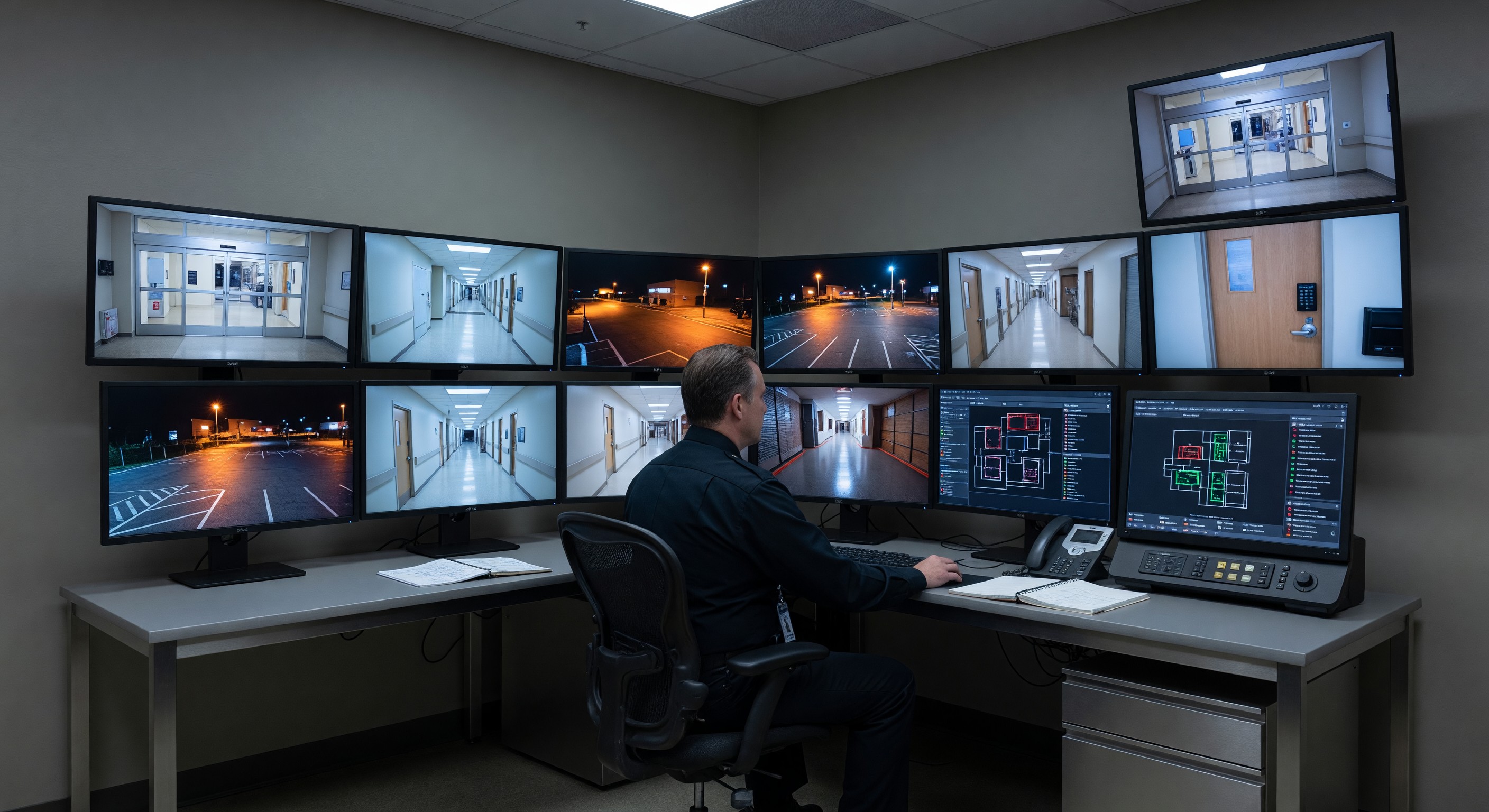
A healthcare security operations center (SOC) is the nerve center of campus security management—the physical space and technology platform from which security staff monitor access control events, camera feeds, alarm activations, and emergency communications across the entire campus. For large healthcare campuses with complex security infrastructure, a well-designed SOC transforms reactive security response into proactive security management.
Many healthcare security programs operate without a dedicated SOC, relying instead on security officers patrolling the campus and responding to individual calls. This works at some scale but fails when the volume of security events, the geographic scope of the campus, or the sophistication of threats exceeds what can be managed through patrol-based response. Understanding when and how to build a healthcare SOC—and what it takes to operate one effectively—is increasingly important for security directors at medium and large healthcare organizations.
When a Dedicated SOC Is Warranted
Not every healthcare organization needs a dedicated security operations center. Factors that support SOC investment:
Campus Scale Organizations managing 1 million square feet or more of clinical and support space, with multiple buildings and complex vehicular and pedestrian access patterns, typically benefit from centralized monitoring that can track conditions across the entire campus simultaneously.
Security System Complexity When the number of cameras (200+), access control doors (500+), and monitored alarm points exceeds what can be effectively managed through separate system consoles, a unified SOC platform provides the integration needed for effective monitoring.
Incident Volume Healthcare organizations that document 100+ security incidents per month benefit from centralized incident tracking, response coordination, and data analysis that a SOC enables.
24/7 Operations Healthcare organizations that maintain 24/7 clinical operations and require around-the-clock security monitoring are natural SOC candidates. A staffed SOC provides continuous monitoring coverage with the technology infrastructure to support rapid response.
Physical Design of the Healthcare SOC
Location SOC location should balance security (access-controlled, not accessible to the public or patients) with operational functionality (accessible to security staff, close to the campus command center used for emergency operations). Many healthcare SOCs are located in the security department suite adjacent to dispatch functions.
Workstation Design SOC workstations must support extended hours of video monitoring and data analysis without causing operator fatigue. Ergonomic workstation design—adjustable monitors at appropriate height, comfortable seating, adequate lighting without monitor glare—directly affects SOC effectiveness. Individual operator workstations with dedicated monitor arrays for camera viewing, access control monitoring, and incident management allow effective multitasking.
Display Wall Large-format display walls or video walls that provide shared situational awareness for the entire SOC team allow supervisors and multiple operators to simultaneously view campus-wide conditions during major incidents. Display walls are particularly valuable during emergency events where incident command functions are coordinated from the SOC.
Redundant Communications SOC design must include redundant communications infrastructure: hardwired telephone systems (not just VoIP that fails during network outages), radio communication base stations for campus-wide radio network management, and emergency communication links to local law enforcement and emergency management agencies.
Power Redundancy The SOC must have reliable emergency power (Critical Branch connection) since it is a critical function during the emergencies when the SOC is most needed. UPS backup for short-duration power anomalies, combined with generator-backed emergency power, ensures SOC continuity during power events.
Technology Platform Selection
Video Management System The VMS is the core SOC technology platform. Enterprise healthcare VMS platforms (Genetec, Milestone, Avigilon) support the scale, integration, and reliability requirements of healthcare campus security. Key evaluation criteria:
- Camera count scalability (can it support projected camera growth?)
- Integration with access control, visitor management, and intrusion systems
- Analytics integration (AI-powered video analytics for proactive alert generation)
- Multi-site support for health systems with multiple campuses
- Remote access for supervisor review from off-site locations
Unified Security Management Platform Where VMS and access control platforms don’t fully integrate, a Physical Security Information Management (PSIM) layer can unify multiple security systems into a single operational view. PSIM platforms are justified for the most complex multi-vendor security environments.
AI Video Analytics SOC camera monitoring is a high-fatigue task that requires human vigilance across dozens or hundreds of camera feeds simultaneously. AI video analytics that automatically detect specified behaviors (loitering, tailgating, crowd formation, abandoned objects) and generate alerts reduces the monitoring burden while improving detection rates.
Incident Management Software Dedicated security incident management software (Omnigo, Resolver, IntelliSite) tracks incident creation, assignment, response, and resolution in a structured format that supports post-incident analysis, trend reporting, and documentation for legal and regulatory purposes.
SOC Staffing Model
Operator Staffing Most healthcare SOCs require at least one dedicated monitoring operator on each shift, with supervisor coverage for first and second shifts. The operator-to-camera ratio is a key staffing driver: human operators can effectively monitor approximately 16–25 cameras with AI analytics support. Without AI support, effective monitoring capacity drops significantly.
Supervisor Structure A security supervisor who maintains SOC situational awareness while also managing field operations provides the operational authority to dispatch field officers and coordinate with clinical and administrative leadership during incidents.
Emergency Coordination Role During declared emergencies, the SOC transitions from routine monitoring to incident command support—providing real-time situational awareness, communications coordination, and access system management to the Hospital Incident Command System. SOC staff should receive ICS training and understand their role in emergency operations.
SOC Performance Metrics
Alarm Response Time Time from alarm activation to SOC operator acknowledgment. Industry targets vary by alarm priority, with life-safety alarms requiring sub-60-second acknowledgment.
Camera Coverage Availability Percentage of cameras delivering usable video at any given time. Camera unavailability (offline cameras, obscured lenses, poor lighting) creates monitoring blind spots. High-performing SOCs target 98%+ camera availability.
Incident Detection Rate What percentage of security incidents are detected proactively by SOC monitoring versus being reported after the fact? Higher proactive detection rates indicate more effective monitoring and analytics.
Response Time from SOC Dispatch to Arrival From the moment the SOC dispatches a field officer to incident arrival time. This metric drives officer deployment decisions and patrolling strategies.
Frequently Asked Questions
How much does it cost to build a healthcare security operations center? SOC buildout costs vary significantly by size and technology scope. A basic single-campus SOC with 100–200 cameras and integrated access control might require $200,000–$500,000 in technology and construction. A large multi-campus health system SOC with 500+ cameras, AI analytics, and PSIM integration might require $1–3 million in initial investment. Ongoing operating costs include staffing, software licensing, and maintenance.
Can a SOC be shared across a health system’s multiple campuses? Yes—a centralized health system SOC that monitors multiple campus deployments is operationally viable and economically attractive for health systems with 3+ campuses. Network connectivity between campuses must support video and access control data transmission; sufficient bandwidth and redundant connections are prerequisites. Centralized SOC models typically require 24/7 staffing at the central location with reduced security presence on individual campuses.
How should healthcare facilities handle SOC staff fatigue from continuous video monitoring? Sustained video monitoring is cognitively demanding work. Best practices include: rotation of monitoring tasks (not dedicated camera-watching for an entire shift), mandatory break schedules, AI analytics that reduce the human attention required for routine monitoring, and workstation ergonomics that reduce physical fatigue. Organizations that treat SOC monitoring as equivalent to passive security guard duty will consistently have performance below potential.
What cybersecurity protections should a healthcare SOC implement? The SOC houses sensitive security technology that should be specifically protected: dedicated network segmentation for SOC systems (separate from general campus networks), strong authentication (MFA) for all SOC platform access, encrypted remote access for authorized off-site connections, and physical access control limiting SOC entry to authorized security personnel. The SOC as a critical security asset should be included in the healthcare organization’s IT security vulnerability management program.