Hospital campus perimeter security sits at the intersection of patient access, operational efficiency, and physical threat mitigation. Healthcare facilities must remain accessible to patients arriving in medical emergencies, staff reporting for around-the-clock shifts, and the constant flow of vendors, contractors, and visitors that keep clinical operations running. At the same time, the same campuses house vulnerable patients, controlled substances, valuable equipment, and large numbers of potential targets that make them attractive to a range of threat actors.
Perimeter security planning that effectively addresses these competing demands requires a layered approach built around realistic threat modeling, not just a checklist of security hardware.
Threat Modeling for Healthcare Campuses
Effective perimeter security begins with understanding the specific threat environment for the facility. Healthcare campuses face a distinct threat profile that differs from commercial, government, or industrial environments:
Vehicle-Based Threats Mass casualty vehicle attacks on crowded public spaces have elevated the priority of vehicle control in high-density areas. Hospital emergency department drop-off zones, main entrances, and ambulance bay approaches represent concentration points where vehicle barriers warrant specific consideration.
Active Threat Events Healthcare facilities have experienced an increasing number of active threat events—including workplace violence incidents that originate in clinical areas and extend into public spaces. Perimeter security that can rapidly lock down the campus to contain an active threat and prevent outside actors from entering is an operational requirement.
Theft and Burglary Hospital campuses house valuable medical equipment, pharmaceutical supplies, and IT infrastructure that attract property crime. Perimeter security that limits access to areas housing these assets reduces theft risk.
Unauthorized Access Patient abductions, custody disputes, and individuals seeking unauthorized access to specific patients represent a significant category of perimeter security concern in pediatric, psychiatric, and labor and delivery environments.
Campus Security Zone Design
Defense in depth—multiple security layers from the campus perimeter inward to the most sensitive areas—is the design principle underlying effective healthcare campus security.
Outer Campus Zone The transition from public street or shared access road to the campus proper represents the first security layer. At this boundary, wayfinding signage, camera coverage, and lighting establish the beginning of the controlled campus environment. Most campuses don’t restrict movement at this boundary—the goal is situational awareness and documentation, not access control.
Controlled Entry Points The primary access control layer typically occurs at parking structure entries, main surface lot entrances, and pedestrian entry paths where individuals transition from the general campus to the controlled building access zone. Barrier gates, credential readers, and staffed checkpoints at these points create the first active access control layer.
Building Entry Layer The second active layer controls transition from the campus exterior to building interiors. Main hospital entrances are typically open access during staffing hours with visitor management processes. After-hours building access is restricted to credentialed staff through card access. Secondary entrances are typically card-access-only around the clock.
Internal Restricted Areas The innermost security layers control access to specific areas within buildings: medication storage, pharmacy, operating suites, labor and delivery, psychiatric units, neonatal intensive care, and data centers. These areas require credential access at all times.
Vehicle Control at Campus Entry Points
Vehicle control at healthcare campus entry points requires balancing security against the operational imperative of emergency access. A cardiac arrest patient cannot wait for a security checkpoint while ambulance crews rush to the ED.
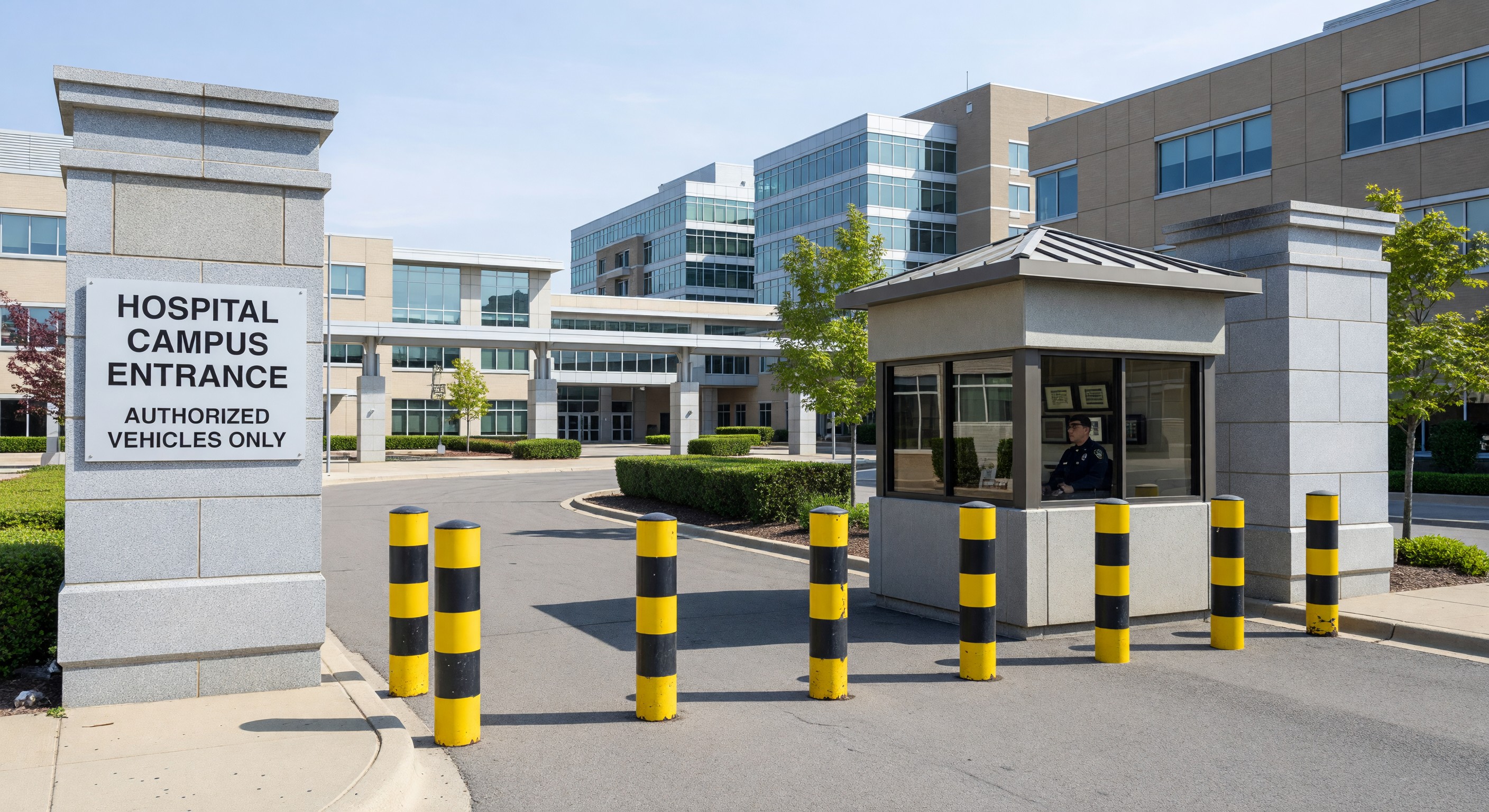
Passive Vehicle Control Landscape features, bollards, planters, and curbing that direct vehicle traffic flow and prevent vehicle approach to pedestrian-heavy entry points provide security without active access control. Passive barriers are appropriate at building entrances and pedestrian plazas where uncontrolled vehicle access poses safety risk but controlled access would impede patient flow.
Active Removable Barriers Hydraulically or electronically operated bollards at emergency department vehicle approaches can be lowered for authorized vehicles and raised during security events. These are appropriate at controlled access points where vehicle traffic requires both routine access management and security lockdown capability.
Parking Structure Barrier Gates Barrier gates at structured parking entries control vehicle access to campus parking while generating revenue and permitting enforcement. High-cycle barrier gates designed for healthcare environments must balance security function with the extreme cycle volumes—thousands of cycles per day—typical of active hospital campuses.
Pedestrian Screening and Entry Management
Controlling pedestrian access to hospital campuses requires a nuanced approach that respects the needs of patients in distress while maintaining appropriate security standards.
Open Access Hours During staffing hours, most hospital main entrances are appropriately open—the presence of reception staff, security personnel, and wayfinding signage manages access without formal screening. This approach serves the patient access imperative while maintaining a visible security presence.
After-Hours Access Control After normal business hours, entry points transition to card-access-only for staff, with a limited number of staffed entrances for patients and visitors. Emergency department entrances typically remain open 24/7 with security observation. All other entrance points are secured.
High-Sensitivity Areas Pediatric, psychiatric, neonatal, and maternity units require additional pedestrian access controls given specific threat profiles. Airlock vestibules, overhead cameras, and security intercom systems control access to these areas independent of the building-wide access management approach.
Camera Coverage for Perimeter Security
Complete camera coverage of the campus perimeter and all entry points is a foundational requirement for effective perimeter security. Camera placement strategy for healthcare perimeters should provide:
- Clear identification-quality images of all individuals entering and exiting at each controlled entry point
- License plate-readable images at all vehicle entry points
- Coverage of all exterior doors, loading docks, and secondary access points
- Coverage of all parking areas and pedestrian pathways on the campus exterior
- Overlap coverage that eliminates blind spots at transitions between zones
Healthcare campus camera infrastructure requires weatherization for outdoor installation and should be integrated with the facility’s video management system and, where applicable, AI-powered video analytics for real-time alert capability.
Emergency Lockdown Capabilities
Healthcare perimeter security must include documented lockdown procedures and technical capabilities to rapidly secure the campus during active threat events. Key components:
Remote Lock Control Security operations should be able to remotely lock all card-access-controlled doors on the campus simultaneously, transitioning from normal access to lockdown mode without physical action at each door.
Automatic Barrier Activation Vehicle barriers at controlled entry points should be activatable from the security command center to immediately secure vehicle access points during emergencies.
Communication Integration Campus lockdown must be integrated with mass notification systems—overhead paging, digital signage, alert systems—to immediately communicate lockdown status to everyone on campus.
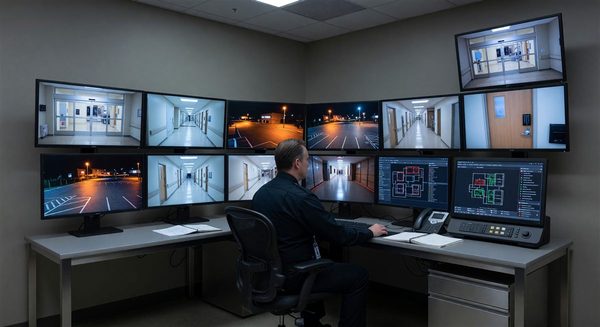
Incident Command Support The physical security command center should be able to provide incident commanders with real-time camera access, access event data, and campus map overlays to support active threat response.
Frequently Asked Questions
What are the highest-priority perimeter security investments for a hospital with limited capital budget? Camera coverage and after-hours access control deliver the highest baseline security value for most healthcare campuses. Complete camera coverage of all entry points and parking areas provides both deterrence and investigative capability. After-hours access control that limits non-emergency building entry to credentialed staff significantly reduces unauthorized access events.
How should healthcare facilities handle the tension between open campus access for patient care and perimeter security? The resolution is zone-based security design. The outer campus is accessible to all—directing traffic, establishing presence, providing wayfinding. Building entries during staffed hours are appropriately open with active visitor management. After-hours and restricted area access is tightly controlled. This layered approach maintains patient access while providing meaningful security protection.
What are the legal and liability considerations for vehicle barriers at hospital entrances? Vehicle barrier installations in areas with pedestrian traffic require careful engineering to avoid creating trip hazards or blocking ADA accessible routes. Retractable barrier systems must have safety features that prevent operation when pedestrians are present. Consult with legal counsel regarding duty of care implications for active barrier systems and ensure installations comply with applicable building codes and ADA requirements.
How often should healthcare facilities conduct perimeter security assessments? Annual perimeter security assessments are a best practice minimum, with interim assessments triggered by significant events (active threat incidents at nearby facilities, changes in campus layout, new construction affecting access points). Many facilities engage external security consultants for periodic independent assessments to identify vulnerabilities that internal teams may miss through familiarity with the environment.