Emergency departments operate at the intersection of open public access and high-security clinical care. Patients arrive in crisis, family members are stressed, and staff face unpredictable encounters around the clock. Security design in the ED is not a luxury — it is a foundational patient and staff safety requirement addressed directly in Joint Commission Environment of Care (EC) standards.
Facility directors overseeing emergency department renovation or new construction must understand how physical layout, access control technology, and operational protocols interact to create a safe care environment.
Why the Emergency Department Demands Special Security Attention
The ED is statistically the most dangerous area in a hospital for workplace violence incidents. The Occupational Safety and Health Administration (OSHA) consistently identifies healthcare workers — particularly those in emergency settings — as facing elevated assault risk. Contributing factors include:
- Open access: unlike surgical suites or ICUs, EDs must accept walk-in patients
- Behavioral health presentations: patients in psychiatric crisis or under the influence of substances
- Long wait times creating frustration and agitation
- Weapons risk: trauma patients or companions may be armed
- 24/7 operation with reduced staffing during overnight hours
Security design must address all of these factors without creating a hostile or unwelcoming environment that deters patients from seeking care.
Zoning and Controlled Access Points
Effective ED security begins with clear zone delineation. Most security consultants recommend a three-zone model:
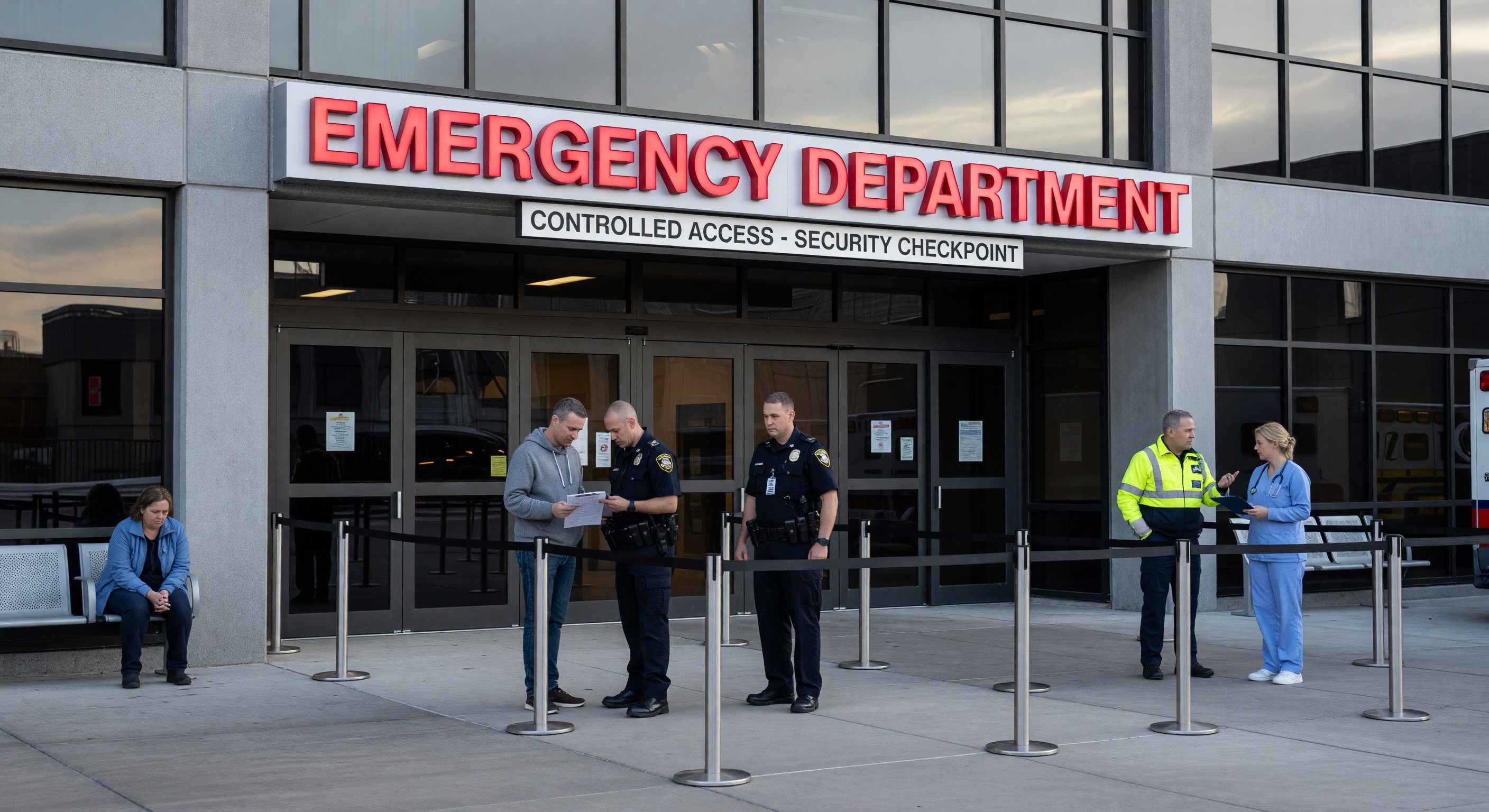
Public zone: The waiting area, triage lobby, and family consultation rooms. Public access is permitted but monitored. Video surveillance coverage should be comprehensive, with camera placement reviewed against Joint Commission EC.02.01.01 requirements for assessing security risks.
Semi-restricted zone: Treatment bays, nursing stations, and medication rooms. Access is controlled by credential — typically staff badge plus PIN at controlled door points. Visitors may enter with escort only.
Restricted zone: Trauma bays, resuscitation rooms, medication storage, and staff-only corridors. Full credential access control with no public access. Duress alarms should be installed at all nursing stations and within reach of providers in these areas.
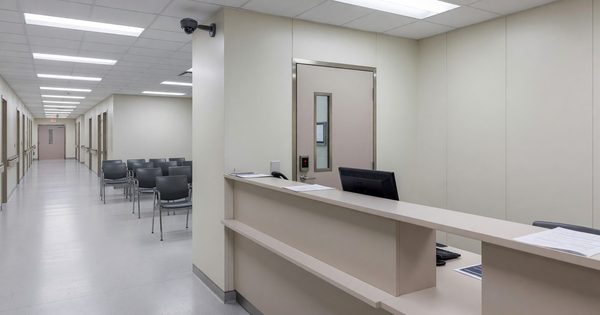
Physical barriers — including curved reception desks with height designed to prevent vaulting, locked medication rooms, and separation between triage and treatment areas — reinforce electronic access control.
Entry Control Technology
Modern ED entry control balances security with throughput. Options include:
Mantrap vestibules: Double-door entry systems that allow only one door to open at a time. Appropriate for high-risk EDs in urban trauma centers. Requires staff monitoring to manage throughput during surges.
Video intercom with remote release: Staff can verify visitor identity and grant or deny entry without leaving the treatment area. Integrates with video management systems for audit trails.
Badge readers with anti-passback: Prevents credential sharing or tailgating. Logs entry/exit data for incident investigation.
Security screening: Metal detectors or weapon detection systems at entry points are increasingly common in high-volume urban EDs. Magnetometer technology has advanced significantly — newer systems use AI-based threat detection that reduces false positives and maintains patient flow.
The appropriate technology suite depends on patient volume, violence incident history, and the ED’s community setting. A Joint Commission-compliant security risk assessment (required under EC.02.01.01) should drive technology selection.
De-escalation Space Design
Physical environment design can reduce agitation before it becomes aggression. Evidence-based principles include:
Reduced wait time perception: Private or semi-private triage alcoves, visual progress indicators, and clear sightlines to staff reduce patient anxiety during waits.
Sensory reduction rooms: Quiet rooms with reduced lighting and sound for patients in behavioral health crisis. These spaces allow de-escalation without physical intervention and reduce the likelihood of elopement or assault.
Family separation options: Separate family waiting from general waiting when possible. Crowded, undifferentiated waiting spaces increase tension.
Clear staff visibility: Open nursing station designs with 360-degree sightlines improve staff awareness of developing situations. Avoid high walls or blind corners in waiting areas.
Duress and Panic Systems
Every ED should maintain a duress alarm system integrated with hospital security response. Requirements under Joint Commission EC.04.01.01 (security management plan) include documented procedures for security incidents, staff training, and annual drills.
Duress system components:
- Fixed panic buttons at nursing stations, triage desks, and treatment areas
- Wearable staff duress badges with GPS or RTLS integration for locating the sender
- Silent alarm protocols that notify security without alerting the aggressor
- Integration with overhead paging and security dispatch
Response time targets should be defined in the security management plan and measured through drill exercises.
Behavioral Health Patient Considerations
Patients presenting in psychiatric crisis require specialized design accommodations:
- Ligature-resistant hardware: Doors, hinges, and fixtures in behavioral health holding areas must meet ligature resistance standards per NFPA 101 and The Joint Commission’s behavioral health environment requirements.
- Environmental safety checks: Remove potential weapons of opportunity — IV poles, visitor chairs with metal legs, and unsecured equipment.
- Clear egress for staff: Treatment room layouts should position staff near exit doors, not cornered by the patient.
- Observation capability: Seclusion rooms require observation windows or camera coverage with documented monitoring logs.
Staff Training as a Design Complement
Physical design addresses environment; training addresses human response. OSHA’s Guidelines for Preventing Workplace Violence for Healthcare and Social Service Workers recommend a violence prevention program that includes:
- Site-specific risk assessment
- De-escalation training for all clinical staff
- Annual security drills
- Incident reporting and root cause analysis after violent events
Facility directors should coordinate with nursing leadership and security management to ensure physical design investments are supported by trained staff response protocols.
Frequently Asked Questions
What does Joint Commission require for ED security specifically? The Joint Commission does not have ED-specific security standards but requires hospitals to conduct a security risk assessment (EC.02.01.01), maintain a security management plan (EC.04.01.01), and report and analyze security incidents. The risk assessment should specifically address high-risk areas including the ED.
Are metal detectors required in emergency departments? No federal regulation or Joint Commission standard mandates metal detectors in EDs. However, CMS Conditions of Participation require hospitals to maintain a safe environment. Metal detector programs are a risk-based decision guided by incident history and community violence levels.
How often should ED security design be reassessed? Security risk assessments should be conducted at least annually and following any significant incident, renovation, or change in patient population. The Joint Commission requires documented annual review.
What is the role of the facility director versus the security director in ED security design? The facility director owns the physical environment — access control hardware, camera placement, room design, and duress system infrastructure. The security director owns operational protocols and staffing. Effective ED security requires close collaboration between both roles, typically through the Environment of Care committee.