Door hardware in a hospital is not a commodity purchase. A lever handle, a door closer, or a latch mechanism in a clinical corridor will be used thousands of times per week by staff wearing gloves, patients using assistive devices, and visitors unfamiliar with institutional hardware. It must withstand that use reliably, control infection, support life safety code requirements, meet ADA standards, and function without failure in a 24/7 environment.
Specifying, installing, and maintaining door hardware to clinical standards requires more knowledge than commercial specifications provide — and the lifecycle cost of poor hardware selection in healthcare is measured not just in hardware replacement costs but in maintenance calls, infection control events, and life safety compliance risk.
Hardware Selection Criteria for Healthcare
Cycle rating — Commercial-grade door hardware is rated for 500,000 cycles. Heavy-duty and institutional hardware is rated for 1,000,000 cycles or more. In a hospital with a busy corridor door cycling 1,000 times per day, even 1,000,000-cycle hardware reaches end of useful life in under three years. For highest-traffic doors, specify the manufacturer’s hospital-grade or heavy-duty institutional product line, not standard commercial grade.
Infection control — Door hardware surfaces are touched by potentially infected hands thousands of times per day. Antimicrobial surface treatments (copper alloy, EPA-registered antimicrobial coatings) reduce surface pathogen burden. Hardware design that minimizes crevices and horizontal surfaces where organisms can accumulate is preferable in clinical areas. Hands-free activation (foot pulls, elbow latches, motion-activated door operators) eliminates the touch point entirely.
Material selection — Satin stainless steel (BHMA 630/US32D finish) is the preferred finish for healthcare hardware due to its resistance to hospital disinfectants, which can corrode brass and chrome finishes. Verify that all hardware finishes are compatible with commonly used hospital disinfectants (quaternary ammonium compounds, bleach-based solutions, hydrogen peroxide formulations).
Tamper resistance — In behavioral health units, patient rooms with elopement risk, and secured areas, hardware must be tamper-resistant — not easily dismantled, defeated, or used as an attachment point.
NFPA 101 Hardware Requirements
NFPA 101 (Life Safety Code) imposes specific hardware requirements on doors in healthcare occupancies:
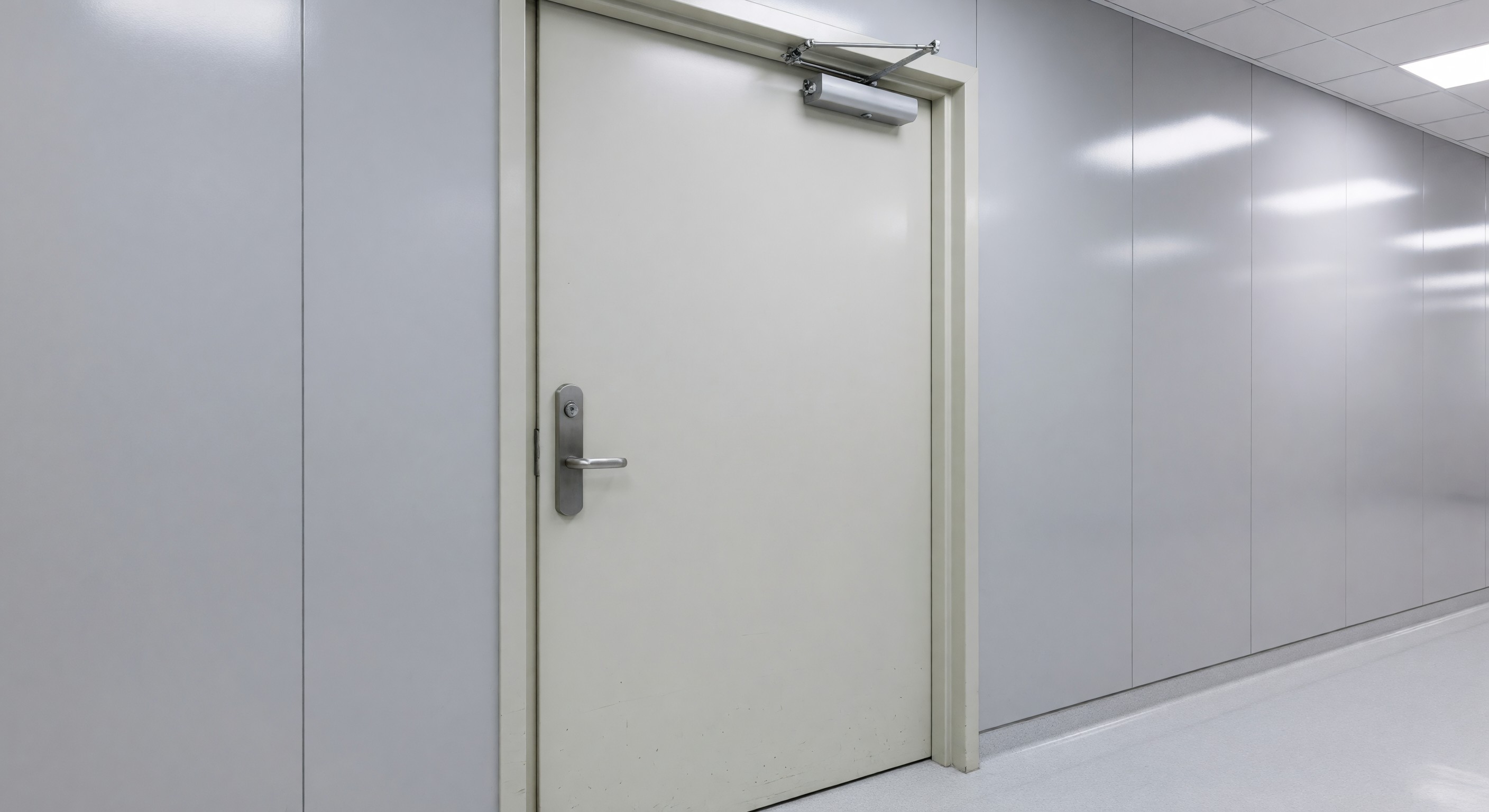
Corridor doors — Doors serving as smoke barriers must latch positively. Self-closing devices are required on all smoke barrier doors. The door must close completely and latch when released — a door that touches the frame but does not engage the latch bolt does not comply.
Exit doors — Doors in the means of egress must be capable of being opened from the inside without a key, special knowledge, or special effort. Panic hardware (crash bars) is required at high-occupancy exit doors. Delayed-egress locks are permitted in healthcare occupancies under specific conditions.
Patient room doors — Patient room doors in smoke-compartmented areas must be self-closing OR have automatic closing via smoke detection. Corridor doors that serve as smoke barriers must comply with smoke barrier door requirements.
Hardware mounting height — NFPA 101 does not specify hardware height, but ADA requirements (42 inches maximum to top of lever handle) and standard practices typically govern placement.
Fire door hardware — Positive latching is required on all fire-rated door assemblies. Fire door hardware must be listed and labeled for use on fire-rated assemblies — not all commercial hardware meets this requirement.
Automatic Door Operators in Clinical Settings
Power-assisted and automatic door operators are standard in patient-facing areas of healthcare facilities. Requirements and considerations:
ADA compliance — Automatic door operators that meet BHMA A156.19 (Power Assist and Low Energy Power Operated Doors) or BHMA A156.10 (Power-Operated Pedestrian Doors) are required at primary accessible entrances. The activation device (push plate, wave switch, or motion sensor) must be accessible per ADA reach range requirements.
Operator speed and force — Doors in clinical areas used by patients with mobility limitations should be adjusted for slow, gentle closing speed. Doors that close too quickly create falls risk, particularly for patients using walkers or wheelchairs.
Safety sensors — Automatic door operators must include obstruction-sensing technology that reverses the door if an obstruction is detected during closing. Sensor adjustment and testing should be included in the PM program.
Power failure behavior — Automatic door operators should fail in the normally-open position (for non-secured areas) or maintain proper latch closure (for fire-rated or security-controlled doors). Confirm fail-safe behavior for each operator installation against the life safety and security requirements of that door.
Keyless and Electronic Hardware
Electronic door hardware — locking mechanisms controlled by credential presentation rather than physical key — has expanded significantly in healthcare settings. Types include:
Electrified locksets — Conventional lock morphology with an electric strike or electric latch retraction component. Request-to-exit (RTE) devices allow egress from inside without credential presentation. These integrate with access control panels at the door level.
Wireless locksets — Battery-powered locksets that receive credential decisions via a wireless protocol (often Wi-Fi or a proprietary mesh). Eliminate door wiring, simplifying installation in renovations. Battery replacement schedule must be maintained.
Electromagnetic door holders — Hold fire doors open for traffic flow; release automatically upon fire alarm activation. Require integration with the fire alarm system via a magnetic door holder controller.
Fail-safe vs. fail-secure — Electronic hardware must be specified with intentional fail-state: fail-safe (electrically unlocked, fail to open) for egress-critical doors; fail-secure (electrically locked, fail to remain locked) for security-critical areas. Never accept the default — always specify intentionally.
Preventive Maintenance Program
Door hardware in clinical environments requires a more intensive PM program than commercial buildings:
Monthly: Inspect all smoke barrier doors for proper closure and latching. Inspect automatic door operators for proper function. Check door closer adjustment on high-traffic doors.
Quarterly: Lubricate hinges, closer arms, and lockset mechanisms per manufacturer specification. Inspect door coordinator function on paired doors. Test electromagnetic door holder release upon fire alarm activation.
Annual: Full hardware inspection by door hardware specialist. Document condition, adjust, and replace worn components. Update hardware inventory.
Document all PM activities in the CMMS and maintain records available for Joint Commission survey review.
Frequently Asked Questions
Why do hospitals frequently have issues with smoke barrier doors not latching? The most common causes: door closer adjusted too slowly (door loses energy before the latch engages), latch bolt misaligned with strike plate (common after flooring changes that affect door height), wear on the latch mechanism, or a door that has warped. A door that does not latch is a life safety finding during Joint Commission surveys. Regular testing as part of the PM program identifies these issues before surveyors do.
Can we install lever handles on patient room doors in behavioral health units? Standard lever handles are generally not appropriate in behavioral health patient rooms due to ligature attachment risk. Anti-ligature lever handles designed specifically for psychiatric environments are available and should be specified for this application. Anti-ligature hardware has no horizontal surfaces or attachment points that could support a ligature.
How do we specify door hardware for bariatric patient care areas? Heavy-duty hardware rated for higher loads, wider door openings (minimum 48 inches clear for bariatric gurneys), slow-closing automatic operators (allowing time for wider equipment), and swing-clear hinges that increase clear opening width. Bariatric care areas should be identified as a special hardware specification zone during any new construction or renovation project.
What is the difference between a fire door and a smoke barrier door? A fire door is a rated assembly (typically 20, 45, 60, or 90-minute rated) designed to resist fire and smoke passage. A smoke barrier door is designed primarily to limit smoke travel and may or may not be fire-rated. In healthcare occupancies, smoke barrier walls (which compartmentalize the building) typically use 20-minute fire-rated smoke doors. Fire stairwell doors have higher fire resistance ratings. Both require positive latching, but the detailed hardware requirements may differ.