Biometric access control — using unique physical characteristics to verify identity — offers compelling security advantages in healthcare settings: credentials cannot be shared, lost, or cloned. The pharmacist who presents their fingerprint at the controlled substance vault is definitively that pharmacist, not someone presenting their badge. For high-security healthcare applications, biometric verification represents the gold standard in identity assurance.
But healthcare environments present specific challenges for biometric systems that commercial building applications do not face: infection control, gloved hands, skin condition variations among clinical staff, and the accommodation of individuals whose biometric characteristics do not enroll reliably.
Biometric Technologies Used in Healthcare
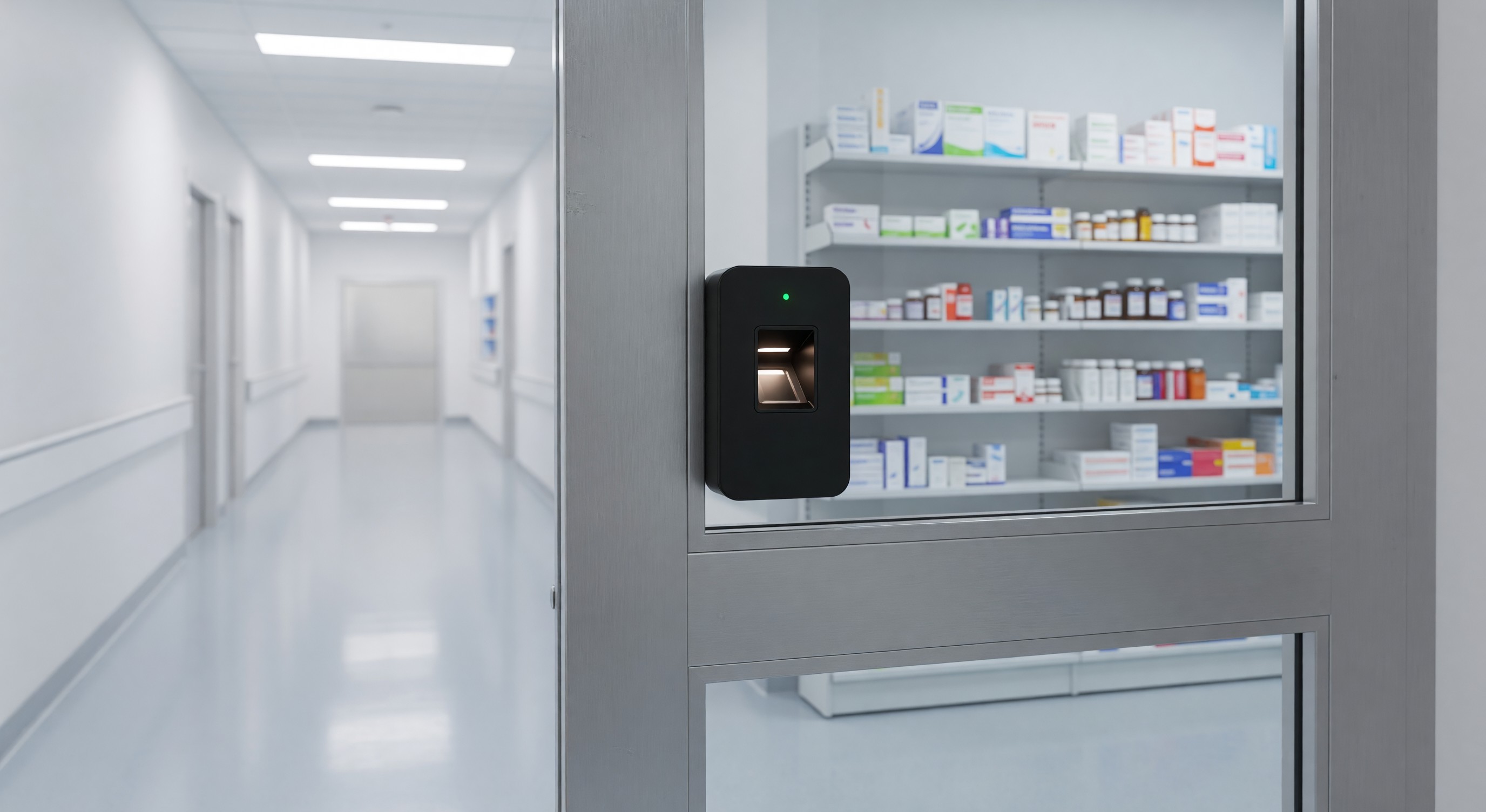
Fingerprint readers — The most common biometric technology. Sensors capture a fingerprint image and match it against a stored template. Contact fingerprint readers require the user to place their finger on a sensor surface. Contactless fingerprint readers (optical systems that capture the fingerprint from a distance) have improved significantly and address infection control concerns about shared touch surfaces.
Iris recognition — Cameras capture the unique pattern of the iris for identification. Contactless, highly accurate, and performs well across a wide population including individuals with poor fingerprint quality. Performance can be affected by eyeglasses, contact lenses, and some iris patterns. Well-suited for healthcare because it requires no touch.
Palm vein recognition — Near-infrared light illuminates the unique vascular pattern in the palm. Contactless, highly accurate, difficult to spoof, and performs extremely well in healthcare because it works reliably regardless of hand hygiene agents, aging skin, or minor injuries that affect fingerprint readers. One of the most infection-control-appropriate biometric technologies for healthcare.
Facial recognition — Cameras match facial geometry against stored images. Fully contactless. Performance has improved significantly but can be challenged by masks (a persistent healthcare reality post-COVID), headwear, and lighting conditions. HIPAA and state privacy law considerations are more complex for facial recognition than other biometrics.
Infection Control: The Critical Healthcare Consideration
Shared touch surfaces in clinical environments are vectors for pathogen transmission. A fingerprint reader touched by hundreds of staff members per day is a potential transmission point — particularly for pathogens that survive on surfaces (MRSA, VRE, C. diff) and for respiratory pathogens during outbreak periods.
COVID-19 dramatically elevated concern about shared-touch biometric devices. Facilities that had installed contact fingerprint readers at pharmacy and high-security access points faced pressure to shift to contactless alternatives.
Infection control assessment for biometric access control should consider:
- Technology type — Contactless technologies (iris, palm vein, contactless fingerprint) are inherently lower-risk than contact technologies
- Location — Biometric readers in highest-infection-risk areas (ICUs, immunocompromised units) warrant higher infection control standards than administrative areas
- Cleaning protocols — Contact surfaces on any biometric reader must have cleaning protocols that are actually feasible in the workflow (who cleans them, how often, with what product)
- Disinfectant compatibility — Biometric reader surfaces must be compatible with the disinfectants used in the facility without degrading sensor performance
For new biometric deployments in clinical areas, specify contactless technology as the default.
Staff Accommodation Challenges
Biometric systems must be able to enroll and reliably identify all staff who will use them. Healthcare settings present specific challenges:
Gloves — Clinical staff frequently work in gloves. Requiring glove removal for biometric authentication at every high-security door creates workflow friction that staff will route around. Plan biometric authentication for doors where authentication frequency is low enough that removing gloves is feasible, or use technologies that work through thin gloves (some contactless fingerprint systems claim glove-compatible operation — verify with the specific vendor under clinical conditions).
Skin condition — Healthcare workers frequently have skin conditions from repeated hand washing and glove use. Chapped, irritated, or slightly macerated skin can affect fingerprint reader accuracy. Palm vein and iris technologies are not affected by skin condition.
Age-related fingerprint changes — Some staff, particularly older individuals, have naturally low-contrast fingerprints that enroll and authenticate poorly with fingerprint systems. Systems must have a compliant fallback authentication method for individuals who cannot reliably use the biometric.
Medical conditions — Some staff may have injuries, prosthetic hands, or other conditions that prevent biometric enrollment. The access control policy must accommodate these staff members with alternative authentication methods.
Implementation in Pharmacy and High-Security Areas
The most common healthcare biometric access control deployment is in pharmacy and controlled substance areas, where DEA requirements and organizational policy demand individual credential tracking:
Enrollment process — All authorized pharmacy staff enroll in the biometric system before system go-live. Enrollment captures multiple samples of the biometric characteristic to establish a robust template. Staff with enrollment difficulties should be identified and accommodated during the enrollment phase, not discovered when they fail to access the pharmacy during a critical moment.
Dual-factor authentication — For highest-security zones, biometric verification can be combined with a smart card (card + finger/palm) for two-factor authentication. The card provides initial credential identification; the biometric confirms physical presence of the credential holder.
Audit logging — Every biometric authentication event must be logged with timestamp, user identity, and door location. These logs support DEA inspection readiness for controlled substance access documentation.
Failure mode — Define the authentication failure mode: how many attempts before lockout? What happens if the biometric system is offline? Who provides alternate access authorization? Test these scenarios before go-live.
Frequently Asked Questions
Is biometric data subject to HIPAA? Biometric data used only for facility access control (not related to patient care) is generally not subject to HIPAA protections. However, state laws in several jurisdictions (Illinois Biometric Information Privacy Act, Texas, Washington, and others) impose specific requirements for biometric data collection, retention, and security. Review applicable state law before deploying biometric systems and implement required notice, consent, and data security provisions.
How long should biometric template data be retained after an employee leaves? Biometric templates should be purged when an employee’s access is terminated. Retaining biometric data after the employee relationship ends serves no operational purpose and creates compliance risk under state biometric privacy laws. Automate purging through integration with the HR offboarding workflow.
What accuracy standard should we expect from healthcare biometric systems? Look for systems with a False Rejection Rate (FRR) of less than 0.1% (1 in 1,000 transactions fails to recognize an authorized user) and a False Acceptance Rate (FAR) of less than 0.001% (1 in 100,000 transactions incorrectly authenticates an unauthorized individual) in the specific operational conditions of healthcare use. Vendor claims should be validated with references from healthcare facility deployments.
Can biometric access control systems be integrated with our existing access control platform? Most enterprise access control platforms support biometric reader integration through standard protocols. Confirm that your chosen biometric device communicates via a protocol your access control system supports (Wiegand, OSDP, or proprietary API). Interoperability should be confirmed with a test before committing to a full deployment.