Behavioral health units in hospitals operate in a unique security environment: the very patients requiring the most intensive psychiatric care may also present the highest risk of self-harm, elopement, or aggression toward staff. Physical environment design in psychiatric settings must simultaneously protect patient dignity, support therapeutic engagement, and prevent the outcomes that bring patients to inpatient behavioral health in the first place.
The Joint Commission, CMS, and The Suicide Prevention Resource Center (SPRC) have all developed guidance on behavioral health environment design. Facility directors with responsibility for psychiatric or behavioral health units should be familiar with these requirements and the engineering and design principles that implement them.
Ligature Risk: The Central Design Challenge
A ligature is any object that could be used to attempt strangulation or hanging — a door handle, a towel bar, a gap in a privacy curtain track, exposed plumbing pipes. Behavioral health environments must minimize or eliminate ligature attachment points in patient-accessible spaces.
Joint Commission NPSG.15.01.01 (applicable to psychiatric hospitals and hospital-based inpatient psychiatric units) requires organizations to:
- Identify patient areas where ligature risks are present
- Develop a written plan to reduce ligature risks
- Implement ligature risk reduction activities
The 2023 Joint Commission update to this standard clarified expectations around ongoing environmental monitoring for ligature risks, requiring a systematic approach to identification rather than point-in-time assessments.
Anti-ligature hardware — The most comprehensive approach to ligature risk elimination is specifying anti-ligature hardware throughout the patient environment:
- Anti-ligature door hardware (lever handles that break away or have no attachment points)
- Anti-ligature toilet paper holders, towel bars, and grab bars (breakaway designs rated to limited loads)
- Anti-ligature window hardware (concealed or breakaway operation)
- Anti-ligature shower fixtures (no protruding elements, breakaway curtain tracks)
- Anti-ligature wardrobe and closet hardware (no hooks, recessed or breakaway clothing rods)
- Anti-ligature lighting fixtures (fully recessed with no exposed attachment points)
- Anti-ligature television mounts (fully recessed or flush-mounted)
Ceiling and overhead — Standard ceiling systems (T-bar grid, surface-mounted fixtures) present ligature attachment points. Anti-ligature ceiling systems use reinforced drywall or specialty grid systems with tamper-resistant mounting that does not create accessible attachment points.
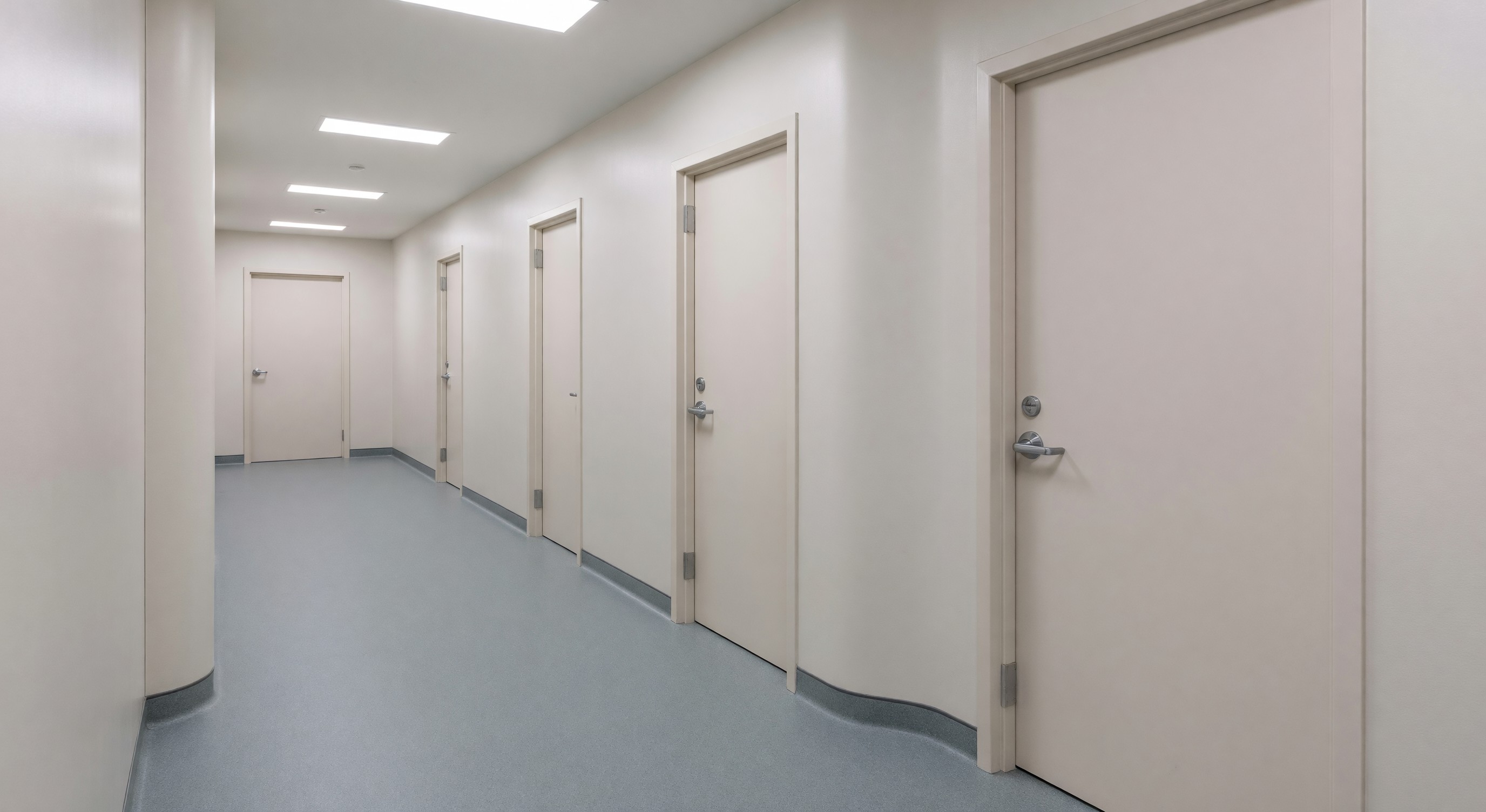
Corridor and common area considerations — Patient-accessible corridors, day rooms, and common areas require the same ligature risk assessment as patient rooms. Pay particular attention to transition zones where standard building features (plumbing chases, structural elements, corridor partitions) are not typically designed with ligature risk in mind.
Elopement Prevention
Elopement — the unauthorized departure of a behavioral health patient from the facility — creates immediate patient safety risk. The access control design must prevent elopement without creating a legally or ethically problematic locked environment.
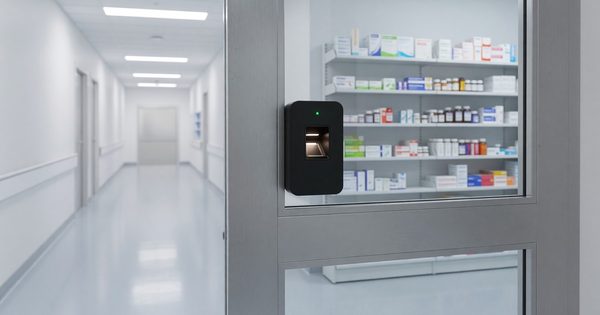
Unit perimeter access control — The entry/exit from the behavioral health unit is the primary elopement control point. Secured doors with access control (staff present credential to exit/enter; patients cannot exit unescorted) define the secured perimeter.
Delay-egress hardware — NFPA 101 permits delay-egress locks in healthcare occupancies. These devices hold the door closed for 15 seconds after push-plate activation, with an audible alarm sounding during the delay period. The delay allows staff to respond. In a fire emergency, the fire alarm signal releases all delay-egress locks immediately. Some jurisdictions require advance approval from the authority having jurisdiction before installing delay-egress hardware.
Elevator access control — Elevators serving the behavioral health floor should require card access for floor selection when traveling away from the unit. A patient who reaches an elevator without staff can be redirected back to the unit by elevator floor security.
Egress design — Balance elopement prevention against life safety. All means of egress from the behavioral health unit must allow immediate exit during a fire emergency. Door hardware must be designed and tested to confirm that life safety override functions reliably.
Staff Safety Systems
Behavioral health staff face assault risk from agitated, psychotic, or substance-impaired patients. Physical environment design reduces risk; technology extends response capability.
Duress alarm systems — Staff in behavioral health units should have immediate access to duress alarms. Wearable duress devices (worn as lanyards, on belt clips, or integrated with staff ID badges) allow a staff member to activate an alarm that pinpoints their location without requiring them to reach a wall-mounted device.
Integration with RTLS (Real-Time Location Systems) provides location data for the alarming staff member, enabling security to respond directly to the specific room rather than conducting a search of the unit.
De-escalation room design — Purpose-built de-escalation rooms allow staff to work with an agitated patient in a safer environment than an open unit:
- Minimum furniture (secured to floor or wall) that cannot be used as projectiles
- No ligature attachment points
- Staff escape door (or door that opens outward for immediate staff exit) separate from the main door
- Window or camera allowing observation from outside the room
- Intercom for audio communication with outside
Safe patient handling in behavioral health — Restraint reduction is a national priority in behavioral health, but when restraints are required, safe patient handling techniques protect both patient and staff. Physical layout that provides adequate space for restraint procedures without furniture obstacles reduces injury risk.
Common Area and Therapeutic Environment Design
A secure environment need not be an institutional one. Research consistently demonstrates that natural light, access to outdoor space, residential-quality finishes (within safety parameters), and control over personal space improve behavioral health outcomes.
Natural light — Maximize window exposure in patient rooms and common areas. Window hardware must be anti-ligature (concealed operation) and anti-elopement (limited opening). Interior courtyard designs allow outdoor views even where exterior windows would present security risks.
Controlled outdoor access — A secure outdoor courtyard accessible from the behavioral health unit allows patients fresh air and physical activity within a controlled perimeter. The outdoor space must be fully enclosed (fence or architectural barrier) and monitored by camera and direct supervision.
Therapeutic materials management — Art therapy, occupational therapy, and recreational activities use materials (scissors, paint, tools) that must be inventoried and controlled. Storage rooms for therapeutic materials require access control with inventory management protocols.
Frequently Asked Questions
How do we determine which areas of a behavioral health unit require anti-ligature hardware? All areas that patients can access unsupervised or with limited supervision require full anti-ligature treatment. This includes patient rooms, patient bathrooms, unit corridors, day rooms, group therapy areas, and outdoor courtyards. Areas where a staff member is continuously present may have reduced requirements, but the risk assessment must be specific and documented. When in doubt, specify anti-ligature — retrofitting is far more expensive than specifying correctly during initial construction.
Does anti-ligature hardware cost significantly more than standard hardware? Anti-ligature hardware typically costs 2–4 times standard commercial-grade hardware. For a 20-bed inpatient unit, the hardware premium is typically $50,000–$150,000 compared to standard hardware. This is a small fraction of the total construction cost and a fraction of the cost of a single adverse event. The business case for anti-ligature specification is strong.
How do we handle renovation of an existing behavioral health unit that does not meet current anti-ligature standards? Conduct a ligature risk assessment using the Joint Commission NPSG.15.01.01 framework. Prioritize high-risk locations (patient rooms, patient bathrooms) for immediate anti-ligature modification. Develop a phased plan for remaining areas. Document the risk assessment, the prioritization rationale, and the corrective action plan. Having a documented plan with progress toward completion is far better than having identified risks with no action plan.
What is the difference between a safe room and a de-escalation room? A safe room is designed primarily for patient safety during a behavioral crisis — minimal furnishings, maximum ligature risk mitigation, designed for the patient to be alone while being monitored. A de-escalation room is designed for therapeutic intervention by staff working with the patient — it includes seating for staff and patient, allows the therapeutic relationship to occur in a safe physical setting. Some facilities design rooms that serve both functions; others maintain separate spaces for each purpose.